
Is your track day approaching fast while suspension components receive upgrades through precise engineering? With genuine Advan wheels, you establish your ultimate lateral grip immediately on the circuit. Forged designs provide unparalleled tensile strength, and coating procedure alternatives present daily economical solutions. Please read our deep technical breakdown before booking your next performance wheel set.
Analyzing Advan Wheels: The Core Forging Vs Casting Debate!


Do you need a high-tension rotational mass reduction for your track chassis today? We have prepared this guide to demystify the manufacturing process that meets strict JWL-compliant standards and divides the premium forged units from standard cast variants.
Here, we provide 6061-T6 aluminum tensile strength and impact absorption metrics along with thermal expansion rates. Today, Advan racing wheels impress drivers with their proprietary forming techniques, and buyers need to come to terms with these engineering facts before they buy rolling hardware.
At RizoForged, our manufacturing analysis distinguishes actual metallurgical information from commercial marketing.
Defining Structural Integrity in Performance Applications
Wheel failures at speed result in catastrophic consequences immediately, so structural integrity can only be analyzed by viewing the metal from a microscopic level. Manufacturers manipulate aluminum alloys using unique processes, and these thermal and pressure processes strictly govern the end yield strength.
- Grain Structure Alignment:Forging aligns the metallic grain precisely along the wheel contours, and this process adds immense strength to the entire wheel structure.
- Porosity Elimination:High-pressure hydraulic presses crush microscopic air pockets in the raw aluminum, so the final metal becomes completely solid and dense.
- Kinetic Load Distribution:Engineers optimize the spoke geometry to deliver kinetic energy evenly across the center hub, and this distribution improves the overall balance perfectly.
- Rapid Thermal Management:Denser forged metals remove brake heat much faster than porous cast alternatives, so your brakes remain cooler during long racing sessions.
Are you laying down 1.5g lateral forces on your suspension every weekend at the track? Conventional cast methods result in random, disorganized grain structures, and such random orientation provides potential failure points under heavy lateral racing forces. According to Vivid Racing, ‘Advan wheels offer unrivaled stiffness and lightweight durability.’
Material Science Behind Advan Wheels: Casting Limitations Vs Forged Dominance!
Familiarity with the physical creation process exposes why each alloy excels in a particular motor sport sector. Engineers choose manufacturing methods based on the required load rating and the target retail cost. Furthermore, these structural differences should be apparent to buyers who are actively seeking stance Advan wheels for sale.
The Gravity Casting Process Breakdown
Gravity casting remains the most widely used manufacturing method world-wide, and facilities directly pour molten A356 aluminum into a pre-heated steel mold. Gravity on Earth draws the liquid metal into the spoke cavities, and this simple process forms the basic wheel shape quickly.
- Extended Cooling Rates:Much slower cooling times produce a much less dense final product, and this longer cooling process affects the overall durability negatively.
- Excess Material Volume:Engineers were forced to use higher mass spokes to pass JWL safety certification, so the resulting wheels become much heavier.
- Severe Weight Penalty:The amount of material needed would need to be thicker due to this stringent requirement, and this extra mass doubles up on weight until vehicles have a severe penalty.
- Reduced Tooling Costs:The cost of production casting molds is much lower than the cost of multi-stage steel forging dies, and this lower cost keeps the final retail price very affordable.
Yield Strength Metrics
The yield strength of cast A356 aluminum reaches about 150 MPa, and this moderate strength plays well with the potholes of daily commuting. However, that specific cast strength does not hold up under the extreme stress of circuit racing compound tires.
Advanced Mold-Forming Forging Technology
Real forging takes serious industrial hydraulic pressure, and facilities heat solid aluminum billets to around 400°C before crushing the billet into the rough wheel shape using massive presses.
This intense pressure changes the physical properties of aluminum at a molecular level. Well, to this very question asked by numerous buyers; are Advan wheels forged? The answer varies greatly from product line to product line.
- 8000-Ton Compression:Industrial presses apply considerable force to shape the raw heated billet, and this massive pressure aligns the internal grain perfectly.
- Maximum Tensile Strength:The metal possesses a maximum yield strength greater than 275MPa once compressed, and this high strength ensures maximum track safety.
- Rotational Weight Reduction:More robust material allows engineers to safely design spokes that are dramatically thinner, and this smart design cuts unsprung mass significantly.
- Extreme Machining Precision:CNC machines cut the final bolt patterns and hub bores to perfection, and this extreme precision guarantees a perfect fitment always.
Factory workers create true mold-form forged products, like the Advan GT wheels, and this unique procedure produces lip profiles that conventional CNC machining cannot safely achieve.
| Feature | Gravity Casting Process | Mold-Form Forging Process | Your Track Performance Metric |
| Alloy Material Phase | Molten A356 Aluminum | Solid Aluminum Billet 400C | Peak Heat Dissipation Rate |
| Applied Forming Pressure | 1G Earth Gravity Pull | 8000-Ton Hydraulic Compression | Internal Structure Alignment |
| Tensile Yield Strength | 150 MPa Baseline Limit | 275 MPa Minimum Limit | Maximum Lateral Load Resistance |
| Component Mass Profile | High Spoke Mass Volume | Thin CNC Machined Profile | Unsprung Rotational Mass Reduction |
Advan Wheels Technical Manufacturing Comparison For Your Vehicle!
Yokohama Advan Wheels Engineering: Flow-Forming as The Middle Ground!
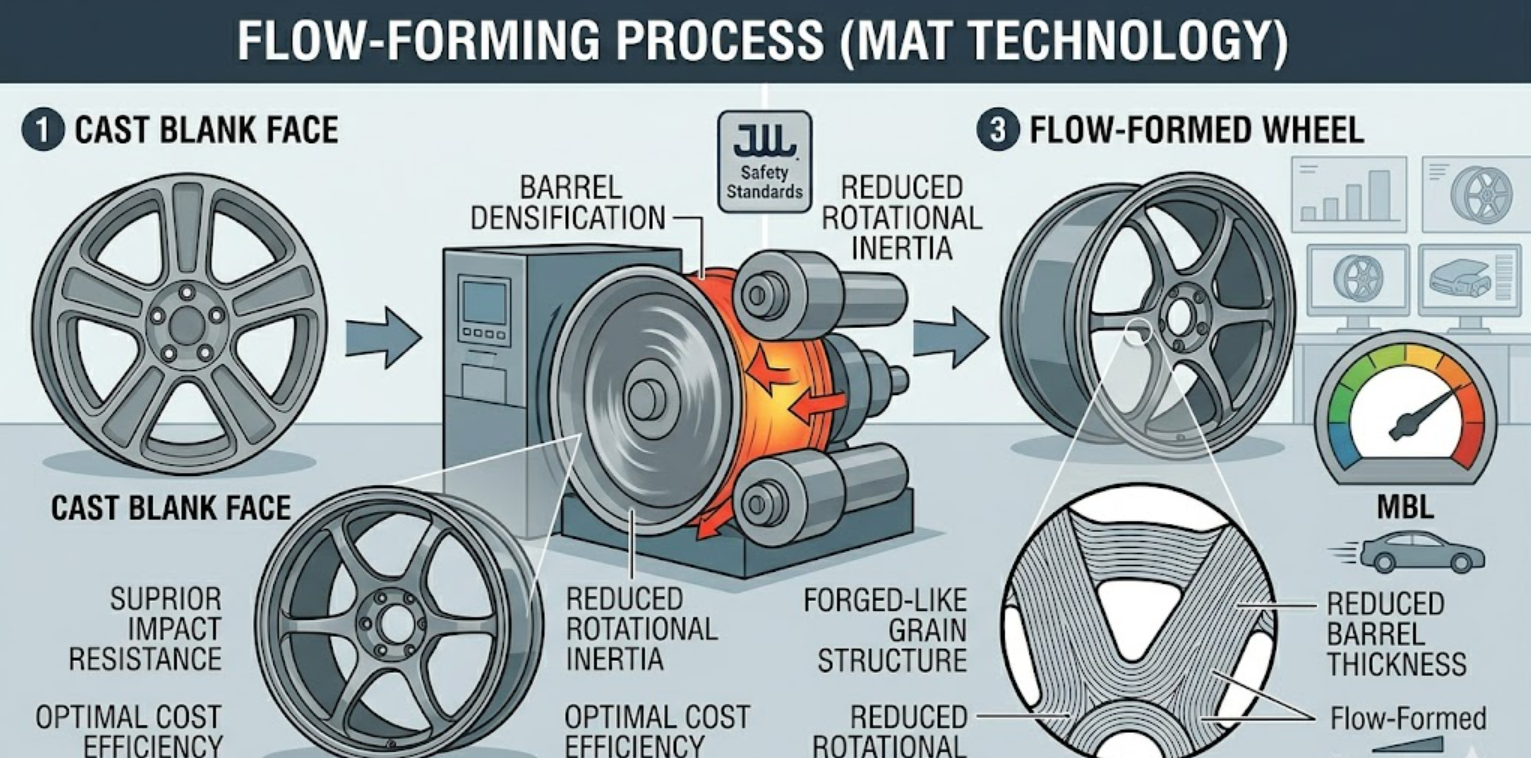
The engineers at Yokohama take a hybrid approach to wring out the best performance while they also manage consumer costs. The company bridges the gap between gravity casting and pure forging using their proprietary Advanced Metal forming Technology. Therefore, drivers need to determine their own driving circumstances before they select a given kind of construction.
Understanding MAT Technology
Flow-forming starts just like a standard cast aluminum wheel face, and then machinery spins this cast blank at extremely high speeds. Heavy steel rollers apply intense heat and pressure to the outer barrel section, and this freer dynamic process stretches and compresses the barrel metal at the exact same time.
- Barrel Densification:The outer rim barrel benefits from a highly compressed forged-like grain structure, and this densification improves the total wheel strength greatly.
- Reduced Rotational Inertia:Thinner barrels reduce rotational mass a lot, which directly improves acceleration, and this weight loss helps cars go much faster.
- Superior Impact Resistance:The compressed outer lip will not bend at hard impacts during the severe curbs on track, and this physical resistance saves drivers money.
- Optimal Cost Efficiency:Customers receive almost-forged barrel strength at a not-pure-forged price, and this smart pricing makes competitive racing much more affordable today.
Steel structures employing such technique are used today in Yokohama Advan wheels and have great structural rigidity. This new Advan rgd2 serves as a perfect demonstration of that flow-forming process, and the deep-dish design helps the structural integrity here with negative offsets that are very aggressive.
Minimum Breaking Load (MBL) Standards
Testing facilities assess wheel strength exclusively through particular MBL metrics. It is safe to say that a regular cast wheel might be able to take an MBL of 500kg per corner. Flow-formed barrels stretch this load cap to around 650kg, and no additional thickness is added to the material, while true forged components regularly rate above 800kg.
Iconic Advan Wheels Geometry: How Design Dictates Structural Load!
Kinetic load dispersion is hugely influenced by geometry, and a five-spoke design distributes stress differently than a multi-poked mesh layout. So, let us deeply analyze some geometries with their practical use cases to understand structural load better.
The Retro Tri-Spoke Revival
Tri-spoke designs were huge in the late 1990s drift scene, and the distinctive Advan 3 spoke wheels not only had their own look but a hefty brake caliper clearance.
- Maximum Brake Cooling:Big vents enable maximum turbulent airflow over hot brake calipers, and this constant airflow prevents serious brake fade entirely.
- Required Hub Centricity:Three wide spokes need a lot of structural material when close to the hub, making them expensive, and this design increases the overall weight slightly.
- Dynamic Gyroscopic Stability:Changes in steering feel occur at high vehicle speeds, and this gyroscopic effect impacts the overall driving dynamics noticeably.
Originally, the famous super Advan wheels used a two-piece modular construction, and this clever design enabled racing teams to replace outer barrels quickly in the pits. Two-piece designs are demanding and need strict hardware maintenance intervals, because titanium assembly bolts must hold precise torque specs 100% of the time.
Modern Track-Focused Layouts
Circuit racing these days requires brutal stiffness on the X-axis, and the Advan tc4 has an aggressive five-spoke design. Engineers embarked on a quest to shave grams, and they added strategic side-cuts along the spokes without sacrificing the structural rigidity. The Advan r6 also features a deep step-lip profile, and such a step-lip supplies exceptional radial stiffness under high cornering loads.
- Anti-Slip Knurling:Little ridges located on the bead seat stop tires from slipping around during hard acceleration, and these small ridges maximize tire grip.
- Oversized Caliper Clearance:Wide spokes sweep the area around monstrous 380mm big brake kits with ease, and this open clearance allows for much bigger brakes.
- Reduced Unsprung Mass:Weight loss at the wheel hub where the suspension meets the tire has an immediate and drastic effect on responsiveness, and this mass reduction makes the car nimble.
Does your current unsprung weight calculation account for the density of specific tire compounds? Heavy track tires and heavy cast wheels overwhelm stock factory dampers immediately. As Car and Driver states, ‘Reducing unsprung mass is the most effective way to improve vehicle handling and suspension response.’
Procurement Realities: Sourcing Authentic Advan Wheels in 2026!
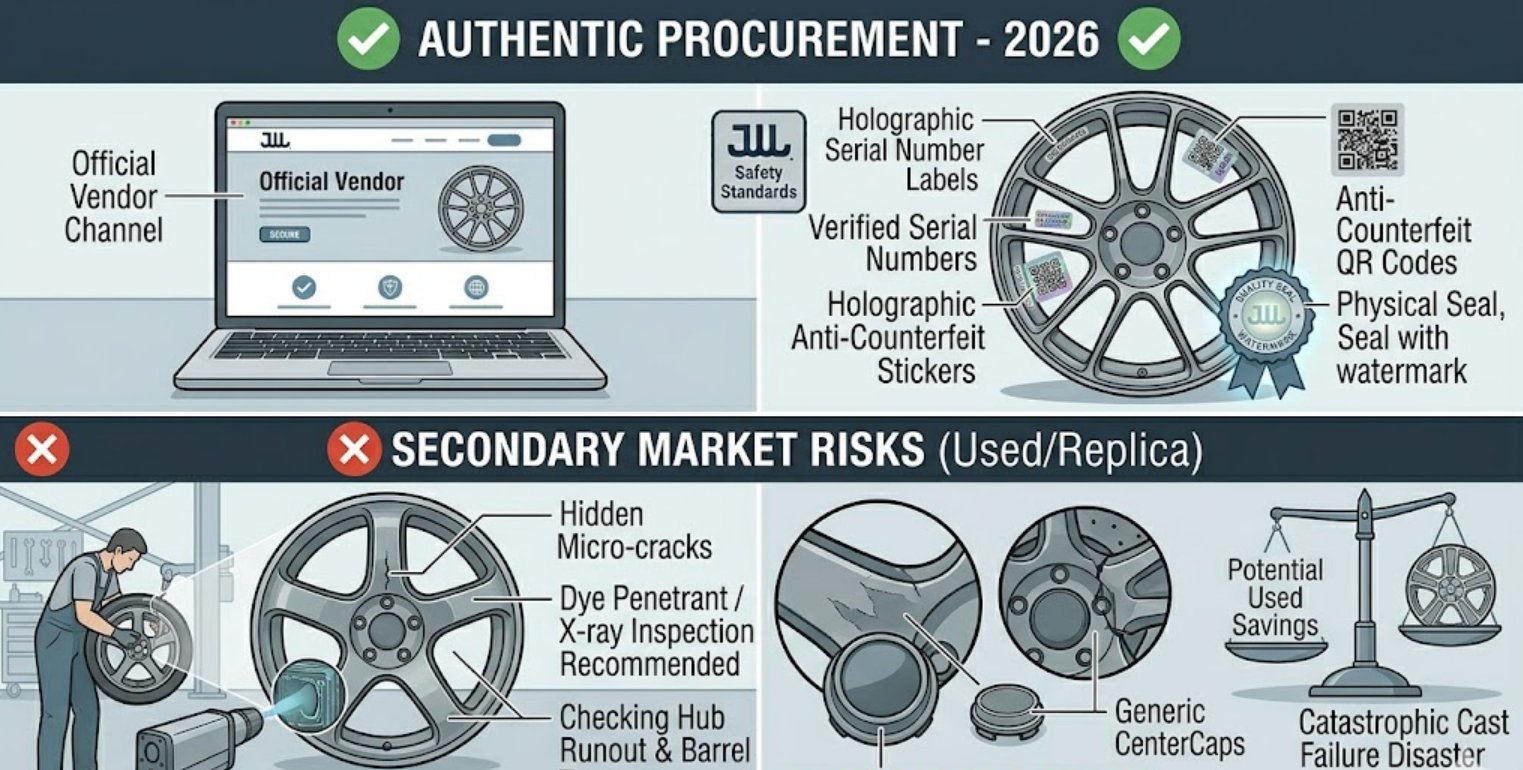
Finding genuine Japanese parts is exceedingly difficult lately, especially since the aftermarket became flooded with dangerous counterfeit replicas. Consequently, buyers must only validate the authenticity via physical serial numbers and official vendor channels to stay completely safe.
Evaluating the Secondary Market
Used track hardware has structural risks built into its purchase, and micro-cracks remain entirely hidden from our untrained human eye. Consumables in forums where Advan forged wheels are being offered for sale should insist on fresh X-ray or dye penetrant inspection reports.
- Checking Hub Runout:Mechanics use a precision mag base dial indicator to measure lateral runout, and this accurate measurement ensures the wheel is perfectly straight.
- Verifying Barrel Trueness:Mechanics check for areas inside the barrel that appeared to have been straightened before, and this careful inspection reveals past crash damage.
- Assessing Hardware Condition:Original Advan racing center caps will show signs of age, such as degradation and cracks, and this visible wear indicates heavy track use.
Cost-to-Performance Ratios
Drivers must assess the real long-term cost of ownership, because the high cost to manufacture Advan wheels is strongly reflected in the initial Advan wheels price.
A set of flow-formed wheels might cost $2,000 today, while genuine forged variants retail well over $4,000. But a cracked cast wheel after a track day will quickly wipe out any potential savings.
Advan Wheels Troubleshooting Scenarios: Track and Street Realities!
Theoretical engineering data is only meaningful if it carries over to real-world reliability, so let us look at two particular manufacturing and maintenance realities faced by pro race teams.
Scenario 1: High-Salinity Environmental Degradation
Drivers working in coastal areas deal with continuous galvanic corrosion, and I remember helping a Florida client who was into raw machined cast wheels on his daily-driven chassis. T
he wheels pitted heavily next to the ground within six months, because the air with high salinity permeated through the micro pores of the cast metal easily. We fixed that problem by stripping and reapplying a thermally cured acrylic clear coat. This fix proves true forged wheels pit less naturally as a result of their ultra-dense, non-porous grain structure.
Scenario 2: High-Tension Cornering Deflection
I once managed a pit crew during a 24-hour endurance race, and our team with standard gravity-cast wheels suffered from severe brake pad knock-back.
Telemetry revealed the wheel spokes bending 3mm at extreme 1.4g cornering loads, and this deflection pushed the brake rotor dangerously close to the caliper pistons. We were able to fix the flex through upgrading to a Mold-Form Forged wheel, and under maximum stretch, the bonded forged spokes held perfect position from the hub to the outer barrel.
Advan Wheels Component Breakdown and Technical Specifications!
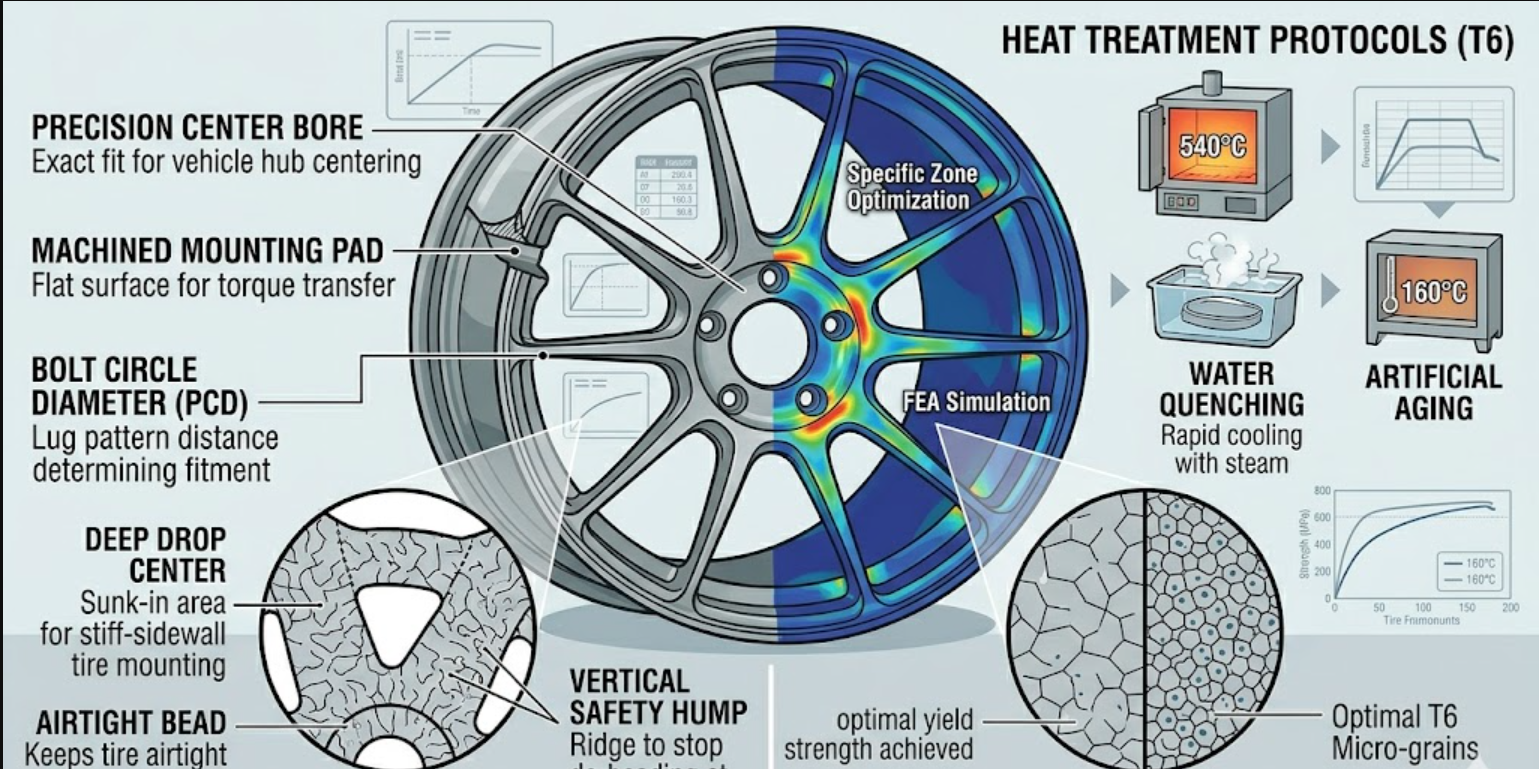
We need to break down the physical components of performance wheels, because every millimeter of material in this design has an engineering purpose. If technicians remove the wrong material, the entire structural assembly becomes compromised immediately. In hope of specific zone optimization, engineers impart intense finite element analysis on these wheel designs.
Essential Hub Anatomy
The Center Bore: This hole needs to be an exact fit for your vehicle hub to prevent vibration during rotation, and it centers the wheel perfectly.
- The Mounting Pad:This is the flat machined surface that mated against the face of the brake rotor, and this flat pad transfers the engine torque.
- The Bolt Circle Diameter (PCD):This measurement is the distance that passes through the middle of every lug hole, and it determines the vehicle fitment accurately.
- The Drop Center:This is the sunk in part to permit the mounting of stiff-sidewall tires safely, and this deep drop helps the tire installation process.
- The Bead Seat:This is the key lip that keeps the tire bead airtight under significant side loads, and this specific seat prevents dangerous air leaks.
- The Safety Hump:This is a vertical ridge that stops the tire from de-beading at super-low pressures, and this high hump keeps the tire secured always.
Heat Treatment Protocols
Aluminum in its raw form is not hard enough to be used in automobiles, so technicians strictly treat finished wheels with T6 heat. We do this by heating the wheel to 540°C, then rapidly quenching it in water, and then artificially aging it at 160°C.
This thermal cycle precipitates strengthening compounds within the aluminum matrix, and the consequence of skipping this step is soft, pliable wheels that give way on even the smallest potholes. Arccaptain experts claim, T6 heat treatment effectively doubles or triples aluminum strength.
Advan Wheels Installation Directives: Protecting Your Forged Hardware!
The right mounting methods keep the structural integrity of your investment intact, but overzealous tire technicians regularly ruin pricey finishes with warped mounting pads using incorrect torque procedures.
Hardware Sourcing and Torque Specs
Do not reuse factory lug bolts that have been stretched, because if you are doing performance applications then you would want forged steel or titanium lug nuts. Put anti-seize compound on the hub face lightly, but never put it on the stud threads. Cutting thread lubrication alters torque readings significantly, resulting in hazardous over-tightening. Has your main torque wrench been calibrated in the last twelve operating months?
- Strict Wrench Calibration:Between your specialty tools, you must have them professionally calibrated a minimum of once annually, and this exact calibration prevents dangerous over-tightening.
- Alternating Star Pattern:Be sure to tighten lugs in an alternating star pattern, so the wheel seats evenly against the vehicle hub surface.
- Mandatory Re-Torque Procedures:Verify all lug nuts after driving the first 50 miles, because thermal expansion loosens hardware initially during early driving sessions.
Cleaning and Chemical Resistance
Harsh acidic wheel cleaners dissolve protective clear coats in seconds, and the harder the wheels are, the more susceptible they are to oxidation from aggressive chemicals.
Alloy wheels that have been forged with an absurdly tight molecular surface structure need extra care, so utilize pH-neutral iron-decontaminating sprays exclusively. Soft-bristled brushes minimize micro-scratching that can occur on delicate gloss finishes, and ceramic coating the inner barrels stops track brake dust from embedding into your paint.
5 Fast FAQs on Advan Wheels Metallurgy!
Do Forged Rims Crack Easily?
Mathematically, the process of forging aligns internal grain structures, and this solid alignment stops catastrophic cracking from occurring rapidly under intense stress loads.
What Does JWL Mean Exactly?
This mark stands for the Japan Light Alloy Wheel Standard, and this strict standard requires stringent impact and fatigue resistance measures for total safety.
How Does Unsprung Mass Affect Handling?
Less unsprung mass means faster damper response times, and lighter wheels help plant tires in quick transitions during tight corners.
Are Flow-Formed Wheels Truly Forged?
Flow-forming utilizes heavy rollers to compress the barrel, and the face remains set while barrels grow stronger through heavy compression.
Can Cast Wheels Survive Track Days?
Good quality gravity cast wheels can handle light or moderate track use, but tooth and nail racing demands real forged structural strength.
Conclusion
Do you want to shave unsprung rotational weight forever to make track days safer instantly? To maximize the performance of your vehicle dynamics, you must upgrade to genuine Advan wheels. Never skimp on your hardware quality, and contact the experts at RizoForged today. Precision manufacturing guarantees an extreme weather resistant life span for intelligent drivers.
 EN
EN  ES
ES  PL
PL  JA
JA  IT
IT