
Stock wheels can fail, so you need to understand are OEM wheels forged or cast. This guide has the answers and will show you 5 simple signs. We explain the simple differences and break down the B2B market for you.
Why Does The OEM Wheel Method Matter?

Why worry about the wheel type? The number one reason is safety. Cast type wheels can crack, which risks far too much on the road. Stronger forged wheels do not crack, and they also offer better performance. Lighter wheels are faster wheels. They reduce unsprung mass, and this means the car handles and stops much better. This explains are forged wheels better than cast.
Using T6-6061 alloy results in a better material. That is the main difference between cast and forged wheels. Your clients will feel this difference, and that is why the method matters so much because the method is crucial and impacts the drive.
Are OEM Wheels Forged Or Cast? A B2B Analysis!

Here is a quick analysis for B2B partners. We will present the data, and you will quickly see the obvious response.
· Primarily Cast
Most factory wheels are typically what are cast wheels. This helps answer the question, what type of wheels forged vs cast are on OEM cars? The reason is for mass production purposes because cost is extremely important in the automotive industry.
Manufacturers employ low-pressure casting, which is a quick and inexpensive wheel production method. The metal is usually A356 aluminum, a common alloy for casting molds, but it is not known for strength. This wide-scale use of A356 aluminum is the main reason a large upgrade market exists.
· A356 Aluminum
A356 aluminum is the industry standard for cast wheels. This alloy is known for brittleness, which makes it crack easily due to porosity. Porosity means small air pockets make the alloy weak. The alloy’s arrangement is dissimilar to forged vs cast aluminum wheels, as the metal’s grain structure is in disarray.
In a density comparison, cast metal is porous like a sponge, while forged metal remains very dense. This specific weakness is the primary reason for all the sales spent on casting products.
· Cost-Effective
Casting is a cheaper production method because of the initial technique. Low tooling cost is the most favorable factor for molds and casts. Labor costs are also low, which means car manufacturers save millions. The price of casting is very low for mass-producing over a thousand items.
But are cast wheels good for performance? They function fine for daily usage but may fail a few safety requirements. These wheels are not for performance, and this compromise is the main reason for the aftermarket opportunity.
· Performance Models
Not all cars are created equal, and some high-end vehicles may have OEM forged wheels. Picture a Porsche GT3, or even some BMW M models. People often ask, are BMW OEM wheels forged? Sometimes they are, because these cars are track cars. They must be strong, and they must be lightweight. The factory knows cast is not enough, which shows forged is the best. When performance is the key, the maker opts for forged, and that is a powerful statement.
· Forged T6-6061
T6-6061 aluminum is the preferred material for high-end wheels. This is a forged, aerospace-grade aluminum. It starts as a solid billet block, so it is not poured. Instead, it is pressed with 10,000 tons of force. This grain alignment process is forging, and it defines the forged wheels meaning. It is stronger because porosity is removed. This is the core of cast aluminum wheels vs forged, as they are polar opposites designed for class.
| Parameter | OEM (Standard) | OEM (Performance) | Aftermarket (Cast) | Aftermarket (Flow-Formed) | Aftermarket (Forged) |
| Process | Low-Pressure Cast | Forged | Gravity/LP Cast | LP Cast + Rotary Forge | 10k-ton Press Forged |
| Material | A356 Aluminum | 6061-T6 Al | A356 Aluminum | A356 Base | 6061-T6 Al |
| Microstructure | Porous / Disarrayed | Dense / Aligned Grain | High Porosity | Cast Face / Forged Barrel | Dense / Aligned Grain |
| Yield/Elongation | ~230MPa / 3-6% | ~276MPa / 10-12% | ~160MPa / <5% | Hybrid (Cast/Forged) | ~276MPa / 10-12% |
| Relative Weight | 100% (Baseline) | ~75% | 100-110% | ~85% | ~70% |
| Impact Response | Crack / Fracture | Bend / Deform | Shatter / Crack | Hybrid (Crack/Bend) | Bend / Deform |
OEM vs. Aftermarket Wheel Technical Comparison!
5 Signs Of OEM Cast Manufact
Manufacturing!

A cast wheel is easy to distinguish from a forged one. There are 5 signs, and you can use these signs for verification.
- Heavier Weight:The cast wheel is the heaviest. I’ve often heard this referred to as “boat anchor” weight in the shop. This is an obvious sign.
- Rough Texture:The inner barrel will not be smooth or polished. The texture feels rough, and this roughness comes directly from the casting mold.
- No CNC Marks:Forged OEM wheels will have visible CNC lines. Cast wheels, on the other hand, have none. A cast wheel is smooth or bumpy, with no signs of machine lines.
- Thick Spokes:A single cast piece of metal is fragile, so manufacturers add more metal to enhance strength and rigidity. This is why the spokes look much thicker.
- Casting Marks:Check the backside of the wheel. The raised letters and dots are formed letters from the mold, which indicates if the wheels are cast or forged wheels.
How To Position Forged Wheels Against OEM Cast?
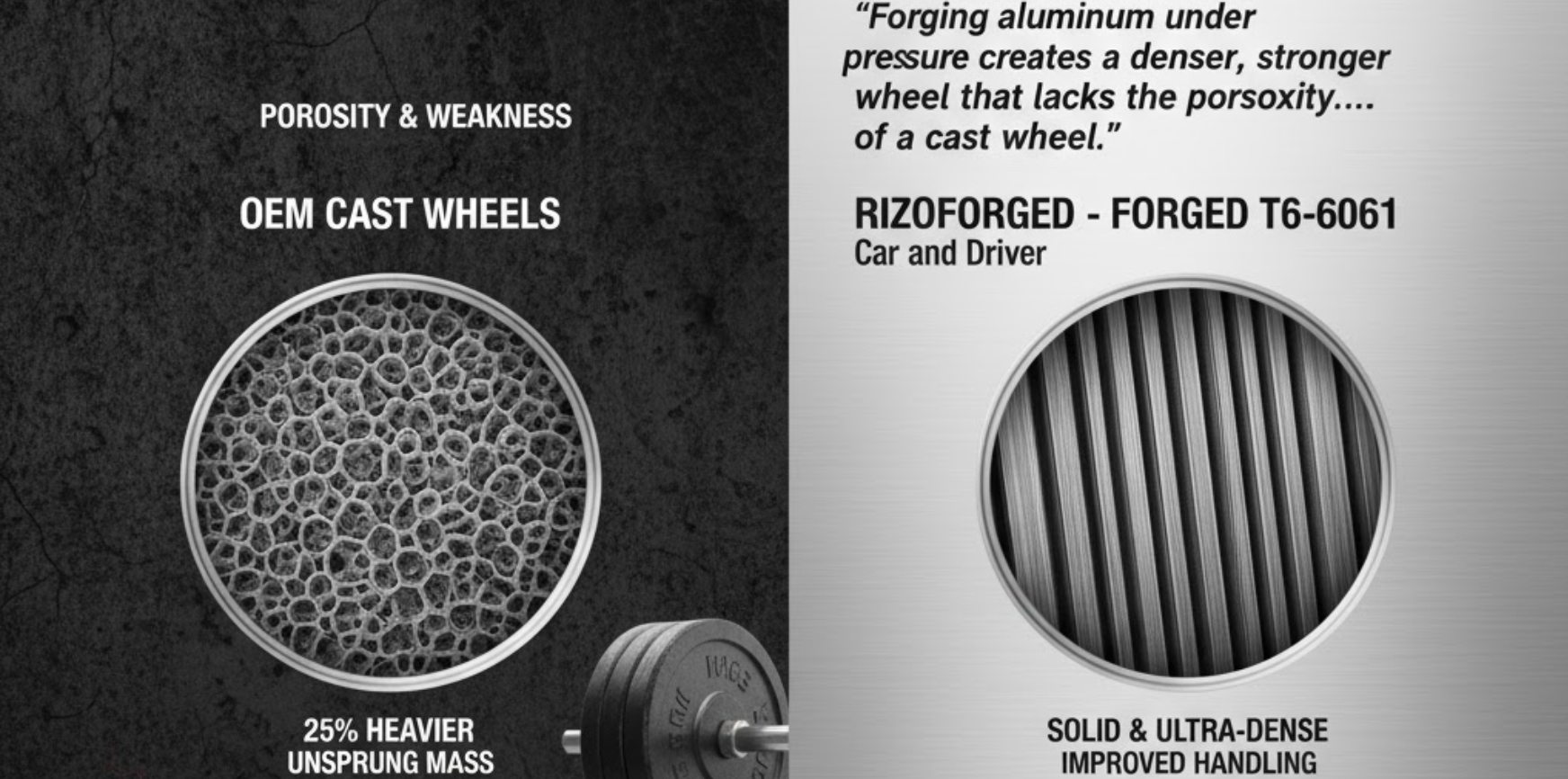
These are the values that you must emphasize to sell the upgrade. These points apply directly to RizoForged partners.
· Highlight Porosity
Ask your clients if they are familiar with porosity. Cast wheels are unrefined and filled with tiny air bubbles. These bubbles are weak points where micro-fractures originate. Then, restate what does forged wheels mean: no porosity, just solid, ultra-dense metal. A wheel becomes denser the more it is forged, and a denser wheel is a safer wheel.
· 25% Lighter
Numbers speak for themselves. Forged wheels are 20% to 25% lighter in comparison. This is a huge fact and highlights the forged vs cast wheels weight gap. This gap is because of the stronger T6-6061 alloy. Your clients feel this difference as the car becomes faster, more agile, and lighter.
· Unsprung Mass
Unsprung mass is the weight not supported by the suspension. Lower-weight wheels mean less unsprung mass, which improves suspension performance. This also keeps the tire on the road, improving handling and braking. This is the core of the forged vs cast wheels argument.
I remember the first time I switched to forged on my own car; the difference in cornering was not subtle. You are not just selling a wheel, you are selling a smoother, more responsive drive.
· JWL/VIA Tests
Suspension arguments build confidence, and our wheels meet JWL and VIA standards. These standards measure impact and load rating, offering a safety guarantee. Not all forged or cast OEM wheels can claim that. This proves your product is safe for high speeds and heavy loads.
· Heat Dissipation
Forged T6-6061 dissipates heat much better. It pulls heat from the brakes, which reduces brake fade. This is critical for performance motorsport cars. Even the best rotary forged wheels cannot do this as effectively. Their face is still a cast piece. A true forged wheel offers better heat dissipation, which translates to safer, more consistent braking on track.
Why The “Cast” Answer Drives Aftermarket Sales?

The OEM cast wheel is your best sales tool, and it creates these five distinct opportunities.
- Failures:When cast wheels fail, clients will come to you once a crack develops, which creates a built-in necessity for an upgrade.
- Bending Risks:Potholes do considerable damage to cast wheels, so this is a much bigger risk. Forged wheels bend less because forged wheels are stronger.
- Poor Handling:The clients will describe feeling the heavy ‘unsprung mass’. They will request a car that has a more agile feel, and that is what you sell.
- Aesthetic Limits:The designs for cast wheels are thick, which makes forged wheels more desirable with their thinner spokes. Have you noticed how bulky a standard OEM focus ST wheels cast or forged wheel looks? This is the style gap.
- Replica Demand:People can identify forged wheels and want to know, are OEM wheels cast or forged? They are, in fact, cast, and this increases the demand for high-quality replicas.
Are OEM Wheels Forged Or Cast: Future Trends!

The wheel market has started to change. This is what we see happening right now, so you must be prepared for it.
· Flow Forming OEM
More OEMs use flow formed wheels or ‘rotary forged’ wheels. This means the face is cast while the barrel is spun. This process makes the barrel lighter, which is better than cast. But it is not true forged, and the cast face remains the most important weak point. This is the key to the flow forged vs cast wheels debate.
· Carbon Fiber
Carbon fiber wheels weigh very little, but they are not the future. A set can cost $15,000. They are also very brittle; they do not bend, they shatter. This is extremely dangerous. Forged aluminum is better because it is safer. This is unlike the material are alloy wheels cast or forged from.
· Magnesium Alloy
Magnesium is lighter than aluminum and is used in some race cars. But it has big problems, as it oxidizes very fast. This is a big deal and is not good for road cars. Do you cast or forge alloy wheels in magnesium? Rarely. Stabilized aluminum is safer, and the best is T6-6061, which is forged.
· Lighter EVs
Electric vehicles are very heavy. The body weight is a lot, so they need light wheels. More range comes from lighter wheels. They also need stronger wheels, and cast wheels are not ideal. The EV market is a big opportunity for forged products. The demand for light, strong forged OEM wheels is increasing, and we are ready for this.
· Hybrid Materials
You can see hybrid wheels with a forged center part and a carbon fiber barrel. This takes rotary forged vs cast to a new level. They are very complex to build and therefore extremely costly. A full monoblock forged wheel is much better for most users, as it offers 90% of the gain with none of the risk.
FAQs!
Below are some of the most common questions we receive. These answers will assist you and your B2B clients.
How Do I Check If My Wheels Are Forged?
Look for fine lines from the CNC machine, which often look like a rainbow. The barrel should feel smooth. If it is cast, the barrel will feel rough. Also, check the back, as it might have a stamp for ‘Forged’ or ‘T6-6061’. The heavy weight is a sure sign of a cast wheel. This is how you check are OEM wheels forged or cast.
Are Forged Wheels Stronger than Stock Rims?
Yes, forged wheels are much stronger; they can be three times stronger. The difference is the metal. Forged metal has a dense grain and is not brittle. A stock cast rim is very brittle and will crack on a bad impact. A forged wheel will bend instead, which is why it is the safer option.
Which Cars Have Forged Wheels Straight From The Factory?
Yes, but it is rare. Consider performance cars like a Porsche GT3 or a Ferrari. People ask, are BMW OEM wheels forged? Some are, but most M Models use heavy cast or flow formed wheels. Cast wheels make up 99% of all cars, which is the reason for such a large upgrade market.
Is Flow Formed Forged?
No. This is why the distinct flow formed vs forged wheels difference is critical. Flow formed is a hybrid. It starts with a cast face. The barrel is spun while heated, which makes the barrel lighter. The face, however, still remains cast. Have you ever wondered what the forged rim meaning is? A true forged wheel is a single, solid, stronger, and seamless masterpiece.
Why Do T6-6061 Forged Wheels Have Higher Prices?
Forged wheels require expensive engineering. The T6-6061 material is also pricey. The 10,000-ton press is a massive machine. Many hours are captured in CNC machining. It is not a low-cost mold. It is a high-tech and valuable piece. What about something like a Miata? Are Miata OEM wheels forged?
Even on a Miata, they are cast. From my experience, a forged upgrade is one of the few modifications that provides a tangible, immediate benefit you can feel. A RizoForged wheel is definitely an upgrade worth having.
Conclusion
You now know the answer of are OEM wheels forged or cast! OEM cast wheels creates a huge sales opportunity. Forged wheels are stronger and lighter, proving they are the best upgrade. Visit RizoForged today and place your orders now.
 EN
 ES
 PL
 JA
 IT