
Are you selecting rims for a vintage restoration? Making the right choice impacts aesthetics and daily performance significantly. We carefully compare cast and forged American racing wheels to help builders decide. Read this comprehensive guide to understand every crucial difference for your custom project today.
A Brief History
Founded in 1956, American Racing is a name that is recognized in the classic car world; the brand invented iconic wheels with high performance characteristics, that is to say, vintage-style and contemporary function. Further still, these mythical wheels are enthusiastically touted throughout the United States, recognized for custom setups with outstanding quality and performance.
American Racing is not a name that is just in the restoration segment, it is a legacy, having been one of the oldest and most trustworthy names in the aftermarket hot rod. Whether it is a ’69 Camaro or 70 Chevelle, there is only one thing that can make or break its stance, and it is not the paint—it is the wheels!
American Racing wheels have been in all sorts of demand and have the old-fashioned look of Torq Thrust which catches the eye. Need help finding the perfect cast or forged wheels or have questions about performance? Our comprehensive guide below has everything you need to find the right one for you with our assistance.
American Racing products have well-tuned engineering, making sure they are producing only quality wheels that are up-to the current pro-touring level. The wheels are also constructed from high quality aluminum alloy, which means that they are extremely robust and secure.
However, do cast or forged American Racing wheels really make sense to your vehicle? We will provide you with a detailed breakdown of their engineering, advantages, quality and much more that will help you decide.
The Take-Home Message
- Great For Money But Not Much Of An Icon:Cast American Racing wheels offer the iconic design at a non-restoration-busting price, but they are a bit heavier than they should be and require a good tire shop for an even vibration (via a Haweka adapter).
- Performance and Precision:Forged variants of the product come from the American Racing Custom Shop with a weight reduction between 25% and 30%, offering the most millimetric accuracy for big brake kits, and feature 6061-T6 aluminum, which is denser and stronger than cast A356.2.
- Upkeep Requirements:Polished lips on any bare aluminum wheel require constant maintenance—with additional cost for PVD and clear coat.
- Time We Need:Custom Forged orders typically take 4 to 12 weeks; it is important that a customer schedule their build dates to allow enough time for their custom-made item to arrive at the garage and prevent any garage delays.
The Following Are Some Main Items To Consider
- Weight is a very important factor. Driving with 6 to 8 lbs less of unsprung massat each corner on a 17×8” wheel makes a huge difference with regards to steering response and braking distances.
- Brake clearance is necessary. Standard (off the shelf) cast offsets will not always fit inside the caliper face for extreme pro-touring setups that feature 14” rotors and six-piston calipers.
- You prefer using special equipment for balancing. Lug-based cast designs must have a Haweka adaptor or a highway lug-used balancer to facilitate prevention of highway shimmies.
- Climate affects finish. In humid climates, polished aluminium finishes will oxidize rapidly, so face a weekly application of a metal polish every three to four weeks.
What’s A Racing Wheel, American? A Quick Definition
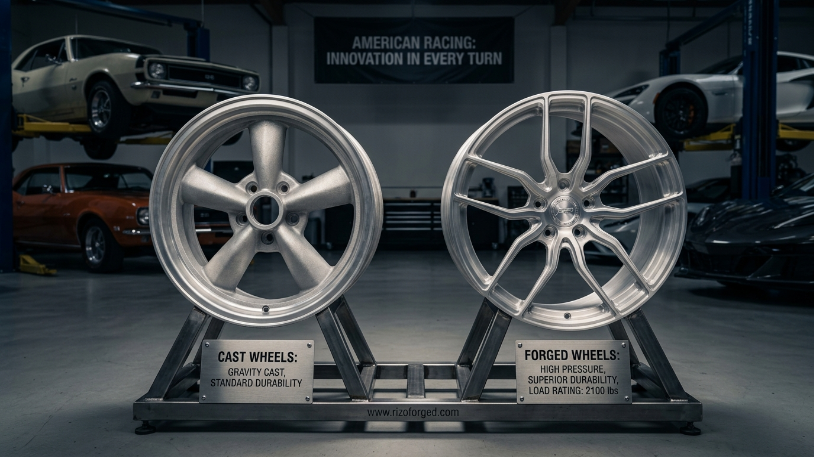
| Feature | Cast Wheels | Forged Wheels |
| Manufacturing | Gravity Cast | High Pressure |
| Durability | Standard | Superior |
For decades American Racing had been designing wheels for vintage muscle cars, hot rods and modern muscle machines. Between the numerous custom made and forged wheels available, including Custom Forged Wheels, there is an American Racing Wheel for each project vehicle. The brand has eminently old roots dating back to the original Torq Thrust design of 1956; a design that was made with the hot rodders themselves in mind, it is a timeless classic today.
Currently, the brand supplies gravity-cast as well as monoblock or 2-Piece Forged Wheels, which are usually 14 to 28 inches in diameter. The cast wheels are cast from aluminum into the mold which ensures that vintage spoke pattern at entry level pricing, much like Classic Wheels. The forged side is quite the opposite, and is handled mostly from the brand’s high end Custom Shop.
In fact, these high-grade wheels are made from 6061-T6 aerospace aluminum which is compressed under intense pressure. In this way, it is possible to obtain a grain structure with a high density which allows the machining of the wheel to an extremely small thickness, comparable to 3-Piece Forged Wheels.
Consequently, they have a low mass and retain a huge 1,580 to 2,100 lb load rating per wheel, exactly like Concave Wheels; American Racing wheels are designed to perform whether you are performing high-speed autocross racing or weekend cruising.
What Exactly Are The Differences Between Cast Wheels And Forged Wheels?
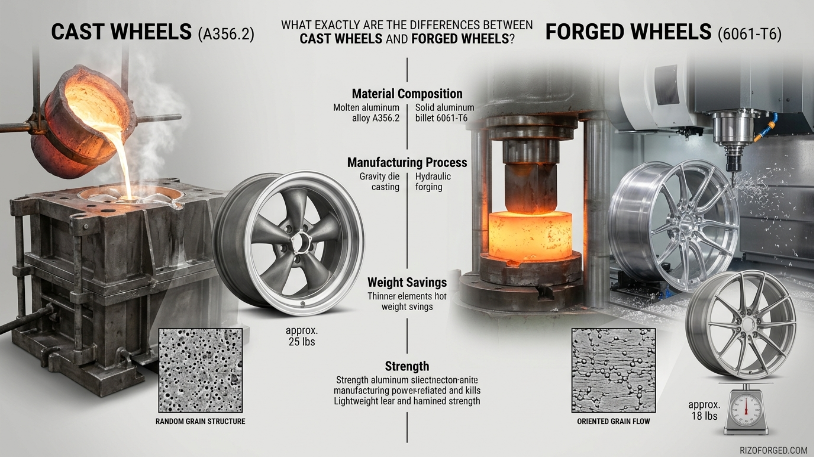
| Specs | Cast | Forged |
| Weight | ~24-26 lbs | ~17-19 lbs |
| Load Capacity | 1,580-2,100 lbs | 1,580-2,100 lbs |
If you have decided to upgrade your ride, you know that there are actually options regarding the type of wheels you can choose, with cast or forged wheels, and making the right decision is all a matter of understanding what each type of wheel is.
Well, what do these production methods entail and more specifically, how do they affect the appearance, performance, quality and cost of your vehicle? A 17×8-inch cast American Racing wheel looks like a solid choice on a spec sheet, but the laws of physics come into play on the street. Let us find out what sets cast and forged American Racing wheels apart and choose the best option!
1. The Differences Between Material Composition
The fundamental distinction between these wheels is the kind of alloyed aluminum that is used even before they even start to form.
- Cast Wheels:Made of aluminum alloy A356.2, it melts cheaply, is easy to melt and is ideal for gravity casting.
- Forged Wheels:Have aerospace-grade aluminum alloy 6061-T6 construction; they are costlier than A356, but their molecular density vastly outweighs.
- Grain Structure:Cast aluminium has a random grain structure that is porous when cooled, while, for forged aluminium, a grain that is oriented and formed into a continuous flow when cooled.
2. The Manufacturing Process
The birth of a wheel has a direct impact on how it is going to react to the stress of a 440 powered Mopar on a twisty mountain pass.
- Casting Process:The casting process for the manufacturing of cast aluminum wheels involves pouring molten aluminum alloy into a gravity die. When the metal cools it becomes the classic Torq Thrust shape.
- Forging Process:Forged wheels are manufactured using solid aluminum billet subjected to extreme high pressure hammering to create wheels.
- CNC Machining:Following forging, a CNC machine removes all redundant parts creating a completely perfect and highly refined wheel.
3. Weight & Rotational Mass Savings
In the Auto-Sport world, rotational mass is bad news. Wheel weight has a huge impact on the suspension’s response to irregular surfaces and on brake stopping power.
- Weight Penalty:Cast wheels come with a few downsides, including the cast has a thicker cross section to meet strength specifications, so it is heavier. Each cast wheel is approximately 24-26 lbs and is 17×8″.
- Weight Saving:Forged wheels are significantly lighter and boost the VC’s performance no time flat; the forged piece is 17×8” and only weighs about 17–19 lbs.
- The Math:By using forged, you save approximately 28% of the rotational mass per corner, resulting in a total loss of 24–32 lbs of unsprung weight from the vehicle.
- Handling Feel:With less momentum to rotate, suspension returns are quicker, steering is crisper and calipers must contend with less momentum when harshly braking.
4. Strength and Load Capacity
While extremely safe, both cast and forged American Racing wheels react drastically to high pressures.
- Load Ratings:Both production processes make wheels with a load rating of 1,580 to 2,100 lbs per wheel to be safe in heavy classics.
- Cast Durability:Cast wheels may not be as tough as forged wheels under absolute and hard extreme forces, but they are definitely more than adequate for road driving.
- Forged Durability:Because of its unique grain structure, forged wheels have a highly compressed structure with great tensile strength and ultimate durability.
- Track Ready:Cast wheels can work fatigued from repeated heating from harsh braking and heavy lateral loads whereas forged wheels are less prone to fatigue.
5. Precision Fitment & Custom Offsets
One of the biggest challenges that make up the custom car world are clearance issues. Do not think that what fits a factory drum-brake setup is going to fit a modern pro-touring build.
- Cast Fitment:Cast wheels are in standard, OEM manufactured sizes designed to fit factory suspensions and standard brakes.
- Forged Customization:Custom forged wheels is absolutely personalized, to the very millimeter, offering custom backspacing and uniqueness PCD.
- Big Brake Clearance:If you are using a Wilwood D8 caliper or a 14-inch rotor conversion, the back of the spokes will not interfere with the brakes and brake clearance problems will be avoided by having custom forged wheels.
- Narrowed Rear Ends:With the buildable Forged rear wheels, builders with narrowed axles can fit deep dish wheels underneath the fenders—no dangerous spacer plates required.
6. Lug-Centric Balancing Challenge
It is an engineering reality that thousands of vintage wheel takers are unaware of when they bring their car in to a world class tyre shop forward.
- Hub-Centric vs Lug-Centric:Modern wheels are hub-centric (centred by the hub bore), while almost all of the vintage-type cast wheels by American Racing are lug-centric (centered around the lug nuts).
- Balancing Errors:In the Standard balancing machine, the wheels are attached to the machine through the centre bore. A shop may balance a lug-centric wheel this way, and get a “perfect” reading on the machine, only to discover that the wheel thumps very badly at 65 miles on the highway.
- The Adapter Fix:To balance out these cast wheels correctly your shop needs a Haweka adapter—which simulates the lug mounting through the holes.
- Lug Nut Seating:On older cast designs, like radials, there are special 60° cone seat lug nuts with narrow shoulders to avoid cracking the wheel seat.
7. Cost Analysis and Overall Investment
Wheels are not all made alike, particularly as far as cost and delivery periods are concerned. It would depend on your budget and the time you have for construction.
- Affordability:If you are on a budget, cast wheels are one of the best and cheapest options on the market, offering a way to achieve that iconic look without breaking the bank.
- Forged Premium:The cost of the materials used in aerospace processes and equipment, in addition to the work and processes a high-quality CNC machine shop must go through to make the forged wheel is what makes this option significantly more expensive.
- Lead Time:AASTRA offers a large inventory of cast wheels in stock and available for shipment within days. Lead times for custom forged orders range up to four to 12 weeks as they are cut to your exact size and specifications.
- Resale Value:With their reputation standing strong in the classic car world, both cast and forged American Racing wheels continue to have a great resale value.
The “Worst” Errors That Builders Make
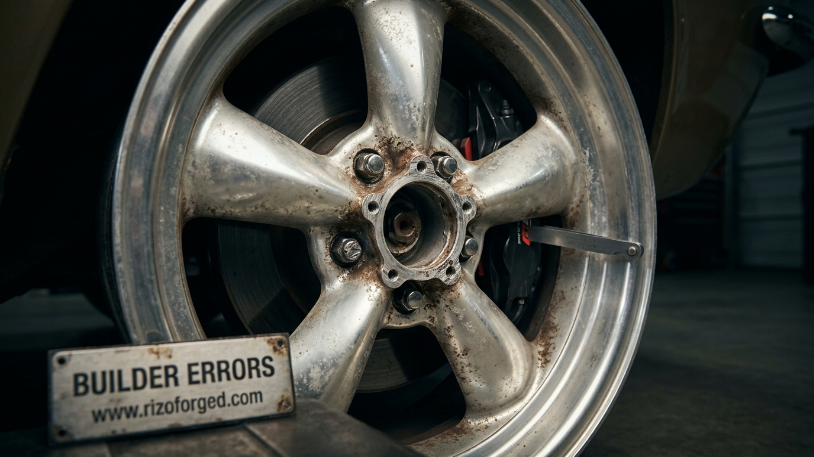
While there are numerous advantages to buying American Racing Wheels, it is prudent to consider potential drawbacks prior to purchase and installation. You have most likely encountered someone who purchased a beautiful set of polished American Racing wheels, installed them proudly and then watched them go milky white and dull in one month.
It is so frustrating! When you order a polished aluminum finish then there is no protective coat on the metal unless you specify a clear coat or a modern PVD finish. However, in the absence of this physical barrier, a silent corrosion process begins that is far more serious than surface staining, caused by the brake dust, road dirt and moisture.
Not performing a routine metal polishing every couple of weeks is the number one reason that we see on great looking show cars, failed vehicles in coastal or humid areas.
Classic car enthusiasts’ other big landmine are offset assumptions. The standard, off-the-shelf offset being shipped to build-outs rarely fails to leave the rotor builder with a brand-new ugly back to their newly upgraded 13” rotor conversion. The American Racing stock cast-offs were intended for factory brake packages, not today’s pro touring hardware.
They probably will require a small spacer and longer studs to get them safely over the caliper if any attempt is made to use them. Take a critical measurement of the gap between the spoke and the caliper; any gap of less than three mm can be sufficient to allow the caliper to vibrate into metal-to-metal contact during hard cornering. The golden rule? If in any doubt, always mock up the brake kit and precisely measure the clearances before ordering.
Lastly, improperly used lug nuts ruin wheels. Vintage American Racing wheels have a 60° conical seat with a shoulder that is much narrower than heavy-duty aftermarket studs. If you have been going to the trouble of making your muscle car 1/2″ thick ARP or 14mm studs, you need a special shank-style lug nut.
The nut may damage the aluminum seat, losing the seating after a few heat cycles or catastrophically cracking the aluminum seat; this is caused by forcing in a nut. It is a small and insignificant detail but can be extremely hazardous on the road.
People Also Ask
Do Cast Wheels Have Enough Strength For Light Occasional Use On The Track?
If you use cast American Racing wheels for a couple weekend autocross runs or just for lapping, they will hold up just fine – they easily clear SAE wheel load ratings. Lateral loads over an extended period can contribute to structural fatigue in the cast grain, while high lateral loading cycles caused by aggressive braking of the track in particular applications can exacerbate the problem. If you are creating a track monster dedicated to it, forged is much more secure and stable.
Were Forged Wheels Better Than Market Bought Ones For Cars?
But yes, it is a subtle and refined improvement. The difference of about seven lbs removed at each corner means that your suspension damps quite easily control the wheel’s movement over poor pavement. In practice, this noticeably blunts that harshness at higher frequencies often through the steering column, and is a smoother, more modern-feeling steering column.
What Is The Longevity Of PVD Finishes Vs Traditional Chrome?
Unlike traditional chrome these PVD (Physical Vapor Deposition) finishes are very hardwearing and will not pit, flake or peel when given to heavy brake dust and road salt. They employ a highly advanced process in which they bond a brilliant metallic layer at a molecular level. Many owners cite reports of four to five years of heavy use with no sign of wear and tear, as they are also a superior upgrade to raw polished aluminum.
Do You Think That The American Racing Custom Shop Is Worth Waiting So Long For?
Yes, if you need to, for your build! For those of you who require a more aggressive staggered setup with a deep rear lip or are looking for clearances for a huge 14-inch rotor, this is the only way to get an exact and bolt on solution with the Custom shop. Waiting for up to 12 weeks can be frustrating but with flawless result it is no need for spacer plates and no fender interference.
What Is The Difference Between A Lug Centric And A Hub Centric?
Hub centric wheels are used to center themselves 100% within the wheel bore on a precisely machined hub ring which bears the car’s weight. But a lug-centric wheel is different, because it is forced to center itself on the hub by the conical-shaped lug nuts. The vast majority of vintage American Racing wheels are lug-centric and that is why they need a special Haweka pin adapt technique when changing tires and getting them balanced.
How Frequently Do I Need Aluminum Wheels To Be Polished?
In humid or coastal climates, they should be polished every two to four weeks to keep the mirror shine or, at least, after heavy rain. Obtain a quality, non-abrasive aluminum polish and a clean microfiber cloth to take off normal oxidation, before it permanently hardens into the soft metal.
Conclusion
Upgrading a classic vehicle demands careful consideration regarding weight, clearance, strength, and your overall budget. While cast options provide affordability, forged American racing wheels deliver unmatched structural integrity alongside massive rotational weight savings for serious street performance. Visit RizoForged today to explore premium custom alloy options and easily find the ultimate setup for your build.
 EN
EN  ES
ES  PL
PL  JA
JA  IT
IT