
Why do heavy rear-wheel-drive sports cars always dominate the tight corners on race day? Track engineers must determine how intimately staggered rims affect lateral grip to maximize your apex speeds. Car mechanics announce wider rear wheels to cope with the colossal torque load. Balancing the mechanical grip dictates ultimate track lap times and tire wear rates.
Staggered Rims vs. Square Setups: Defining the Engineering Parameters!

Are drivers fighting annoying mid-corner snap-oversteer with the factory wheel setup? The main key to optimizing track performance revolves around proper wheel geometry. Master mechanics define wheel setups in exact width and offset measurements for cars.
A square setup features four wheels of the exact same dimension on both vehicle axles. The square layout encourages neutral chassis dynamics, and it allows full four-way tire rotation. During competitive racing events, track enthusiasts always discuss the pros and cons of staggered vs square setups mechanically.
What Constitutes a Staggered Configuration?
Engineers group wheel arrangements per the tire contact patch distribution on the road. Due to specific design needs, staggered setups just need wider rear tires than the front axle. The resulting geometric bias works to deliberately change the vehicle slip angle behavior. Some high-performance car manufacturers insert the staggered format directly into the factory assembly lines. Have drivers ever wondered why sports cars use different wheel sizes?
Staggered Rims Meaning and Core Mechanics
To understand the true staggered rims meaning, racing analysts must review the raw telemetry data. The staggered layout targets the rear-axle traction threshold under heavy engine load. A light steering touch meets responsive front wheels, and those wheels flow into an eager turn-in bite.
Rear wheels determine forward propulsion and track grip during heavy throttle applications. Expanding the rear tire contact patch increases the mechanical grip by an absolute order of magnitude for the vehicle. I remember upgrading my track car last summer, and the wider rear wheels instantly cured my traction loss.
Analyzing Staggered Rims vs Non-Staggered
The crucial measurements become sustained lateral G-forces when mechanics assess staggered rims vs non staggered setups. Square setups also have predictable breakaway characteristics for determining how hard the car can corner at maximum grip.
Racing drivers will enjoy evenly worn tires on all four corners of the vehicle suspension. The rear mechanical grip goes way up to combat power-induced oversteer in various staggered configurations. Swapping track configurations requires drivers to compute suspension bind and roll center changes.
Material Science: Forging the Ultimate Track Wheels!
Wheel manufacturers typically plate high-performance wheels from 6061-T6 aerospace aluminum on the metal blanks. Standard metal casting processes leave microscopic porosities within the internal aluminum structure.
Heavy hydraulic pressure over 10,000 tons aligns the molecular grain structure during the forging process. The forging process produces extraordinary tensile strength with a significant weight saving in the unsprung rotational mass.
Tensile Strength and Load Ratings
Aggressive racing track impacts cause very sharp kinetic energy spikes through the entire car suspension system.
- Yield Strength:The 6061-T6 forged aluminum can experience up to an enormous 276 MPa before the wheel faces structural deformation.
- Unsprung Weight Reduction:A 10 lb reduction of wheel mass equals approximately a 100 lbs reduction in the static chassis weight.
- Thermal Management:Extreme brake rotor heat transfers through dense forged alloys 15% quicker than the standard cast wheel equivalents.
- Fatigue Resistance:The forged grain structure fights against dangerous micro-cracking under sustained endurance racing stints.
Customizing Wheel Offsets and Backspacing
A positive offset means that the mounting hub face sits closer to the outside wheel face. The negative offset offers a more pronounced and much deeper outer lip profile. Track engineers calculate exact millimeter backspacing for the proper clearance of oversized multi-piston brake calipers.
Correct offset calculations will certainly eliminate any metal fender interference during significant suspension compression. “Les Schwab experts suggest, proper backspacing assures wheels clear your vehicle brakes.”
| Specification | Forged 6061-T6 | Cast Aluminum | Track Metric | Your Benefit |
| Manufacturing Pressure | 10000 tons hydraulic | Gravity fed | High structural density | Protects your suspension |
| Yield Strength | 276 MPa | 130 MPa | Prevents metal deformation | Handles your extreme loads |
| Thermal Management | 15% faster transfer | Baseline cooling | Dissipates brake rotor heat | Stops your brake fade |
| Unsprung Mass | 10 lbs lighter | Baseline weight | 100 lbs static chassis equivalent | Lowers your lap times |
| Molecular Structure | Aligned grain | Microscopic porosities | Resists micro-cracking | Keeps you safe |
Forged 6061-T6 Aluminum Versus Cast Aluminum Track Wheel Comparison!
Sizing Applications: From 18 Inch Staggered Rims to 24 Inch!

Drivers must find out if the wheel size becomes an unforgiving matter on the track. The rim size directly determines how high and low the tires are as well as the steering feel. Track-honed race cars need stiffer and shorter sidewalls to reduce tire deflection under extreme lateral loads. The moment of inertia increases exponentially as the overall wheel diameter increases.
Balancing Rotational Mass and Contact Patch
Racing drivers have to consider visual beautification versus the extremely important unsprung weight statistics.
- 18 Inch Staggered Rims:They represent the absolute gold standard for dedicated track vehicles maximizing the best available tire compound options.
- 20 Inch Staggered Rims:These wheels provide the optimal performance balance for modern and heavy high-performance street cars.
- 22 Inch Staggered Rims:These wheels feature a horizontal center cap face which allows custom image configuration, and the visual eye impact remains the primary cause of the stance.
- 24 Inch Staggered Rims:Mechanics reserve these large wheels almost exclusively for custom show vehicles that require massive modifications to the wheel wells.
Chassis-Specific Configurations: Tuning for Platform Architecture!
Can the car chassis produce enough raw rear-wheel torque to actually warrant a 305mm rear tire section width? High-output forced-induction engines easily overwhelm the standard factory rear tire width on the track. Modern heavy muscle cars and European sports sedans will need special staggered geometries to achieve a decent launch.
RWD Dominance: Mustang, Camaro, and Dodge Charger Staggered Rims
Heavy American car chassis utilize very large engines with extremely fat low-end torque curves.
- Mustang Staggered Rims:Most S550 platform track builds use 19×9 front wheel sizes and 19×11 rear wheel sizes.
- Camaro Staggered Rims:Very aggressive +43mm rear offsets become necessary to ensure the suspension components clear the inner wheel surface on Alpha chassis configurations.
- Dodge Charger Staggered Rims:The powerful Hellcat variants need giant 11-inch rear wheel widths just to have a chance at hooking up 707 horsepower.
Both of these heavy platforms depend entirely on maximizing rear tire grip to get the best quarter mile times.
European Precision: BMW Staggered Rims and Geometry
German chassis engineers remain totally obsessive about having nicely balanced vehicle handling dynamics. The typical BMW staggered rims usually feature small and subtle width differences from the front axle to the rear axle.
An M3 car could use 275mm front tread sections and 285mm rear tread sections. The small size delta keeps the steering response very sharp while locking down the massive rear tire grip. Have racing fans ever noticed how smoothly European cars corner on tight tracks?
The AWD Dilemma: Staggered Rims on AWD Systems
Running staggered rims on AWD platforms requires extreme mathematical wariness from professional track mechanics. All four rolling tire diameters must remain precisely the same for active transfer cases.
Mismatched overall tire heights wipe out viscous couplings and high-dollar center differentials within moments. Track engineers carefully calculate the exact tire sidewall aspect ratios to ensure perfectly matched rolling circumferences. “AWD systems demand identical rolling diameters to prevent catastrophic transfer case failure,” according to Car and Driver.
Visual Architecture: Concave and Deep-Dish Designs!
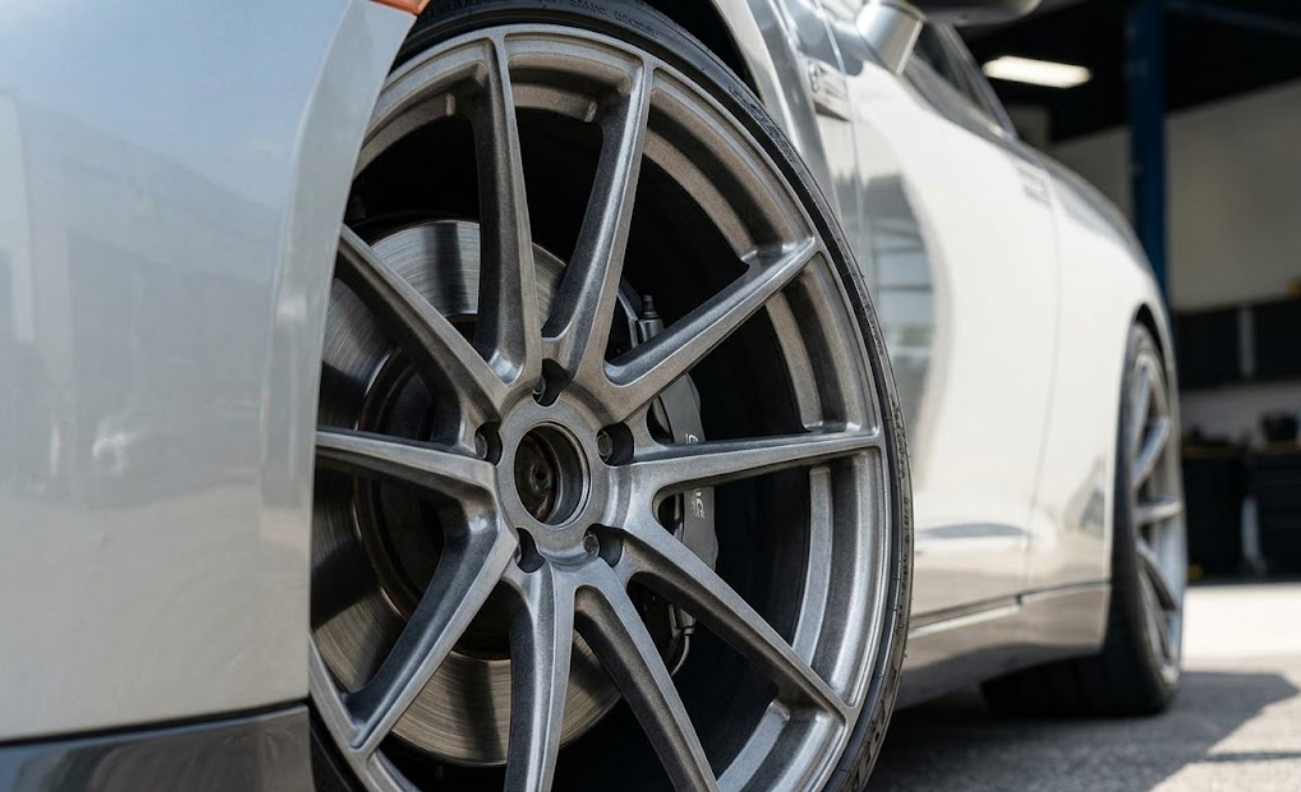
Custom wheel designs progress rapidly as the advanced 5-axis machining technology improves. The latest CNC milling equipment successfully supports very aggressive wheel face profiling while maintaining maximum structural integrity.
Structural Integrity of Staggered Concave Rims
The modern staggered concave rims have massively thick spokes plunging inward aggressively toward the recessed center hub. The concave shape creates an enormous amount of clearance for large brake calipers on the front steering axle. Manufacturers use deeper concavity profiles on the rear wheels to create a visually wider vehicle stance. Automotive engineers use finite element analysis to verify the metal spoke strength under heavy torsional loads.
Traditional Deep Dish Staggered Rims
Extreme negative offsets enable massive and polished outer lips on classic deep dish staggered rims. Restomod builders particularly favor the classic aggressive look when applying heavy modifications to vintage car chassis. Reaching the required wide barrel width means the wheels must have a multi-piece bolted metal construction.
Finish Variations: Black Staggered Rims vs Chrome Staggered Rims
State-of-the-art chemical surface coatings safeguard the bare aluminum wheel bodies against highly corrosive brake dust.
- Black Staggered Rims:Industrial powder coating gives a highly durable and chip-resistant finish that remains essential for heavy track abuse.
- Chrome Staggered Rims:Chemical electroplating procedures produce an impeccable mirror finish strictly intended for controlled show car use.
- Anodized Finishes:Electrolytic passivation adjusts the natural oxide layer to be thicker, and it makes the wheel molecularly scratch-resistant.
Procurement Logistics: Sourcing a Staggered Rims and Tires Package!
Custom forged wheels only provide high performance benefits if mechanics fit them with the correct racing tire compounds. Using incorrect tire rubber compounds will completely ruin the track car handling capabilities.
Serious track racing setups require very specific UTQG treadwear numbers for optimal grip. Buying a full staggered rims and tires package ensures the correct suspension clearance right from the start. Ordering a complete package from RizoForged guarantees a flawless fitment for track days.
Matching Treadwear Ratings to Rim Widths
Global tire manufacturers specify exact rim width tolerance ranges for every single tire size produced globally.
- 275/35R19 Specifications:This tire size requires a 9.0 to 11.0-inch physical rim width for safe mounting.
- 305/30R19 Specifications:The large tire requires a 10.5 to 11.5-inch physical rim width at the bare minimum.
- 325/30R20 Specifications:This massive rubber requires a huge 11.5 to 12.5-inch physical wheel width to operate safely.
Wrapping a skinny tire casing around an unreasonably wide rim means the tire sides enter a state of extreme stretch. The risky stretching behavior reduces tire load capacity, and it greatly elevates the chances of catastrophic tire blowouts.
Real-World Track Scenarios and Maintenance Realities!

Excessive racing track abuse translates into instant mechanical suspension failures for unprepared vehicles. Many drivers mistakenly believe that there are no mechanical limits regarding basic wheel geometry limits. Aggressive drivers will run a track car hard until catastrophic component damage finally occurs. During my first amateur race, I ignored proper wheel offset measurements and shredded a brand-new rear tire.
§ Scenario 1: Rear Tire Rubbing Under Heavy Compression
A driver mounts aggressive 11-inch rear wheels with a meaty +22 wheel offset. The racing car enters a highly banked high-speed corner while pulling 1.2 lateral Gs. The rear suspension bottoms out squarely directly onto the polyurethane suspension bump stops.
The outer tire shoulder hits the sharp inner metal fender lip very aggressively. The resulting heated friction tears the rubber tire sidewall almost immediately. Mechanics correct this bad geometry by machining exactly 5mm off the inner aluminum wheel hub pad.
§ Scenario 2: Understeer Bias on a Square Setup
A race car uses a fully square 275mm setup on a massively front-biased AWD platform. Track conditions go from dry asphalt to torrential rain during a qualifying session. The front tires immediately overheat and lose all mechanical surface grip.
The heavy vehicle quickly pushes toward the outside retaining wall on the initial corner turn-in. A specialized reverse-staggered setup mitigates the grip loss, and it allows the front and rear tires to grip the track surface properly.
How to Choose: Comparing Wheel Specifications and Geometry?
Mechanics must verify incredibly tight mechanical dimensions before purchasing bespoke custom racing wheels. Track builders must forget cliched marketing adjectives, and they must start demanding specific engineering schematics from manufacturers without a shred of mercy.
Critical Wheel Specifications
Professional racing mechanics rigorously verify these exact numbers before they mount a new racing tire.
- Pitch Circle Diameter (PCD):The pitch circle specifies the precise radial distance between the vehicle lug nut studs.
- Center Bore Hub:The wheel center must perfectly match the vehicle hub to avoid violent high-speed vibrations.
- Static Load Rating:The wheel structure must vastly exceed the stated gross vehicle weight rating measured in pounds or kilograms.
- ET (Offset) Measurement:The offset measurement identifies the specific location of the true wheel centerline relative to the flat hub area.
- Barrel Clearance:Wheel barrel clearance defines the required internal space needed to accommodate the floating brake rotor expansion.
Advanced Forging Techniques and Grain Alignment
Rotary flow-forging remains a rock-solid entry-level specification for legitimate automotive track wheels. Real monoblock forging utilizes a single 100-pound solid aluminum cylinder blank. Massive CNC milling machines carve the final intricate wheel design directly from that solid aluminum block.
Builders create modular multi-piece wheels using forged aluminum faces bolted directly to spun aerospace aluminum barrels. “According to Litespeed Racing, monoblock wheels yield superior strength to weight ratios.”
Top 5 FAQs!
What Are The Core Benefits Of Staggered Rims?
Staggered wheel setups heavily assist the rear wheels in hooking up during hard launch conditions on the track. The wider rear tires perfectly handle the huge high-horsepower engine outputs.
Can I Physically Rotate Staggered Tires?
Mechanics can only rotate staggered tires side-to-side across the exact same vehicle axle. Drivers absolutely cannot rotate them front-to-back due to the massive width variance between the front and rear tires.
Do Aggressive Staggered Wheels Cause Understeer?
Yes, increasing the rear tires to a much wider stance adds significant front end push during tight cornering. Drivers methodically configure the suspension sway bars to counteract the severe traction disparity.
Are Staggered Setups Dangerous For AWD Cars?
Mismatched overall tire diameters will instantly destroy the expensive AWD center differentials. Mechanics must mathematically equalize the front and rear rolling circumferences exactly to prevent permanent mechanical damage.
How Do I Accurately Measure Wheel Offset?
Mechanics accurately measure the distance to the nearest millimeter from the true wheel centerline directly to the inner hub mounting pad.
Conclusion
Choosing the correct wheel configuration strictly dictates the suspension response during extreme lateral loads. Mounting properly sized staggered wheels transforms the corner exit acceleration for high-horsepower car chassis. Upgrading track setups requires absolute precision engineering alongside aerospace-grade forged aluminum wheels. Browse our premium custom inventory today at RizoForged to conquer the demanding racing track competition.
 EN
EN  ES
ES  PL
PL  JA
JA  IT
IT