
Have you ever wondered why the factory rims feel so sluggish? Upgrading your ride is pinpoint engineering. Choosing top-tier performance wheels will instantly change how your vehicle handles. Expert shops do backspacing and offset calculations. Professional installation is how we ensure your safety. Serious driving enthusiasts now have the option for better braking.
Understanding Unsprung Mass and Rotational Inertia!

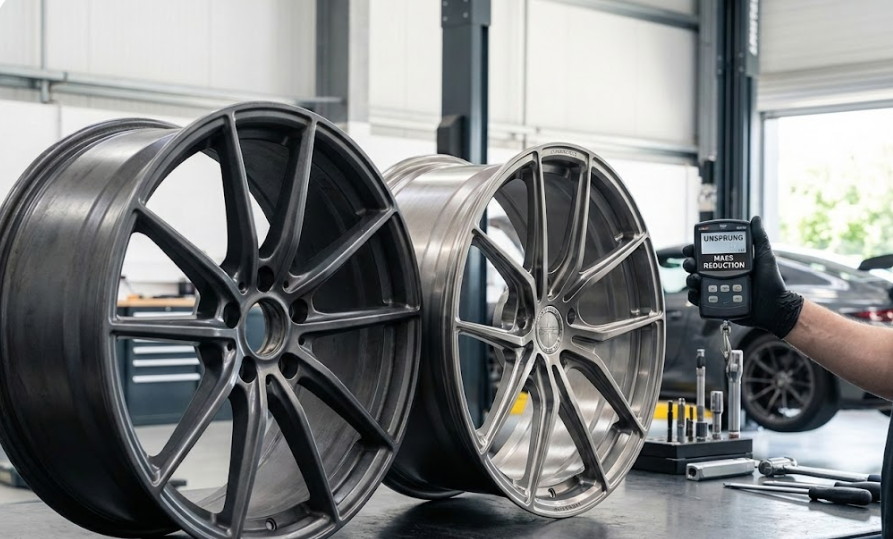
To fully understand why you need to visit a professional shop for aftermarket upgrades you have to know a bit of the vehicle physics. The aim of upgrading rolling stock is for your vehicle to have greater performance and less unsprung mass. Unsprung mass is all the mass of the vehicle that is not supported by the suspension system.
For factory cast rims that means they have high mass and high rotational inertia. This means there will be greater amounts of energy needed to both start and to stop the rim from spinning. Upgrading to a lighter rim will help.
When there is less unsprung mass, the shock and the springs will be able to respond to the road better. The tire will create a better contact patch.
A reduction in rotational mass means the vehicle will be able to accelerate from a stop quicker and will be able to use less fuel because of the way the engine works.
Understanding Scrub Radius!
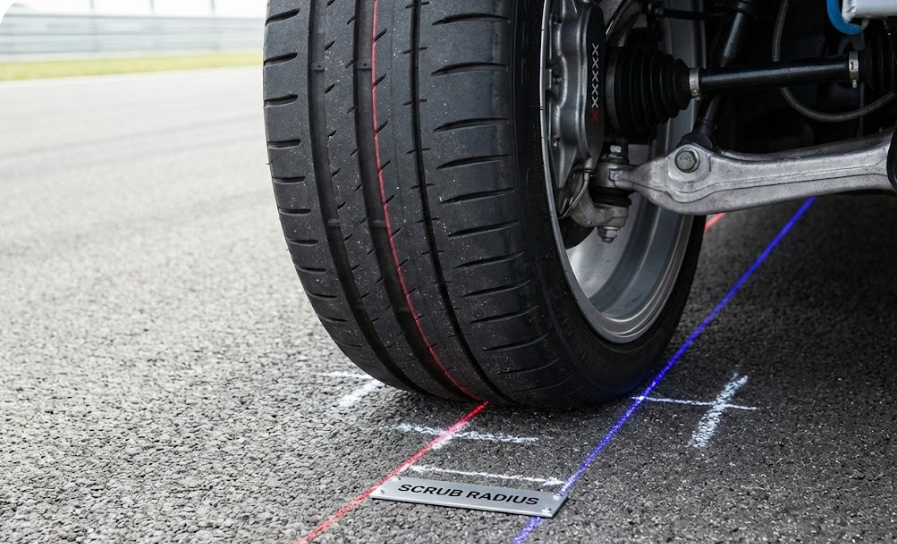
Professional shops don’t just slap parts on; they actually measure the scrub radius. Scrub radius is the distance from the center of the tire’s contact patch to the intersection of the steering axis on the road.
o Positive Scrub Radius
The steer axis intersects the road in front of the tire centerline, typically seen on rear-wheel-drive vehicles.
o Negative Scrub Radius
The steering axis intersects the road behind the centerline. This is often the case in front-wheel drive vehicles; this is often done to improve stability in the event of a front tire blowout.
o Zero Scrub Radius
The steering axis intersects the contact patch center. This is often thought to be a good steering feel, however, this can lead to the steering feeling numb, and braking can be problematic.
The offset of your new rims will change the scrub radius. Professional shops will ensure that your new setup won’t lead to excessive steering input or snap oversteer.
Understanding Manufacturing Methods: Cast, Flow Form, and Forged!
Once you enter a professional shop, the technicians should ask you about your driving activities. Are you doing weekend canyon carving, extreme towing, or building a track car? This will determine your choice of manufacturing method.
1. Gravity and Low-Pressure Casting
Casting means pouring liquid aluminum into a mold. This will be the cheapest option to produce a aluminum part, but due to the chemical properties of the metal, the structure will have small air pockets that make it weaker and heavier than other options.
- Gravity Casting:This type of casting uses no other force than gravity to fill the mold, resulting in more variation in densities.
- Low-Pressure Casting:This type uses a positive pressure to push the molten alloy into the mold. This results in a more uniform and denser grain structure than that of a gravity casting.
Application: Works for everyday driving and looks, but doesn’t apply to the heavy use of a race track.
2. Flow Forming (or Rotary Forging)
Flow forming is between a casting and a completely forged option. It starts with a low-pressure cast face. Then the barrel is heated and spun which results in the use of the high pressure steel rollers to stretch and shape the barrel.
- Grain Alignment:The rolling process compresses the aluminum, thereby aligning the metallic grain structure down the barrel.
- Weight Reduction:Flow formed barrels are as strong as their forged counterparts. This means manufacturers can use less material and save as much as 15% in weight over standard cast options.
Application: A good option for spirited street driving, and entry level autocross customers.
3. Fully Forged Construction
First class when it comes to wheel engineering. A monolithic solid cylindrical billet is made from aerospace-grade 6061-T6 aluminum. This is then subjected to extreme heating and a crushing environment (typically greater than 10,000 tons) from a hydraulic press.
- Monoblock (1-Piece):Each wheel is constructed from a single forging. This provides the best strength-to-weight ratio, and maximum structural rigidity for the most extreme track abuse.
- 2-Piece Construction:Involves a forged center face which is then bolted or welded to a spun forged barrel. This allows for adjustability of face positions and the ability to change faces.
- 3-Piece Construction:This consists of a center face, one inner barrel, and one outer lip which are all “sealed” using aerospace-grade silicone and then bolted together with titanium screws. This allows for endless combinations of width and offset to be adjusted.
Use: This is a must for high-horsepower builds, competitive motorsports, and ultra luxury custom fitments. Many owners seek out Tesla Model 3 performance wheels specifically in a forged monoblock style to maximize their range and acceleration.
| Attribute | Cast Wheels | Flow Formed Wheels | Fully Forged Wheels |
| Production Method | Molten mold pouring | Rotary barrel spinning | 10,000 Ton compression |
| Material Grade | A356.2 Aluminum | Enhanced A356 Alloy | 6061-T6 Aerospace |
| Tensile Strength | 33,000 PSI | 38,000 – 41,000 PSI | 45,000 – 52,000 PSI |
| Weight Status | Baseline Mass | 15% – 25% Reduction | 25% – 30% Reduction |
Technical Comparison of Performance Wheels Manufacturing Methods!
Critical Fitment Specifications a Pro Shop Must Master!
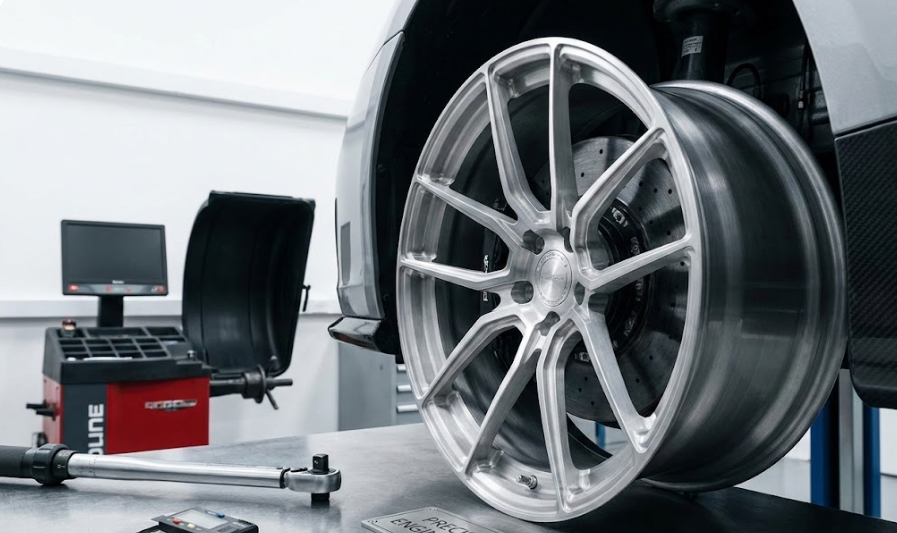
An amateur shop will sell you a design based solely on aesthetics. A professional shop, however, views fitment as an engineering rather than a design process. There are several important factors that must be considered together which are as follows.
ü Pitch Circle Diameter (PCD) and Bolt Patterns
The PCD says a lot about the configuration of the lug holes. It is about the quantity of the lug, and the size of a circle that is imagined and bisects the center of each lug and passes through all of them. (E.g, 5×114.3mm). Precision is crucial. Trying to fit a 5x112mm alloy wheels setup to a 5×114.3mm wheel hub using wobble bolts is unsafe for performance use. Pro shops require the PCD to match exactly.
ü Offset (ET) and Backspacing
These two measurements determine the exact positioning of the wheel within the fender arch.
- Offset (ET):Measured in millimeters. It describes the position of the wheel relative to the wheel hub/spindle assembly.
- Positive Offset (+):The wheel hub is moved to the street side and the assembly is positioned farther into the fender arch.
- Zero Offset (0):The wheel hub is centered.
- Negative Offset (-):The wheel hub is moved to the brake side and positions the assembly outward creating a deep dish
- Backspacing:Measured in inches and describes the distance from the very back edge of the inner lip to the wheel hub. It is a crucial factor in determining the clearance to the suspension components.
ü Hub Centric and Center Bore
The center bore is the hole in the center of the wheel that is machined to fit the hub collar in the vehicle. It must fit precisely.
- Hub Centric Fitment:The bore is made to match the hub exactly (example 66.6mm). The hub takes the vertical load of the vehicle. This ensures a vibration-free experience.
- Lug Centric Fitment:The bore is bigger than the hub. The entire weight of the vehicle is transferred to the lug studs, which can fail due to high shear forces.
The Pro Shop Solution: When fitting aftermarket rims with a larger bore, a pro shop will allow you to fit aluminum hub-centric rings to fill the gap and maintain hub-centric safety.
What To Expect From A Professional Wheel Shop?
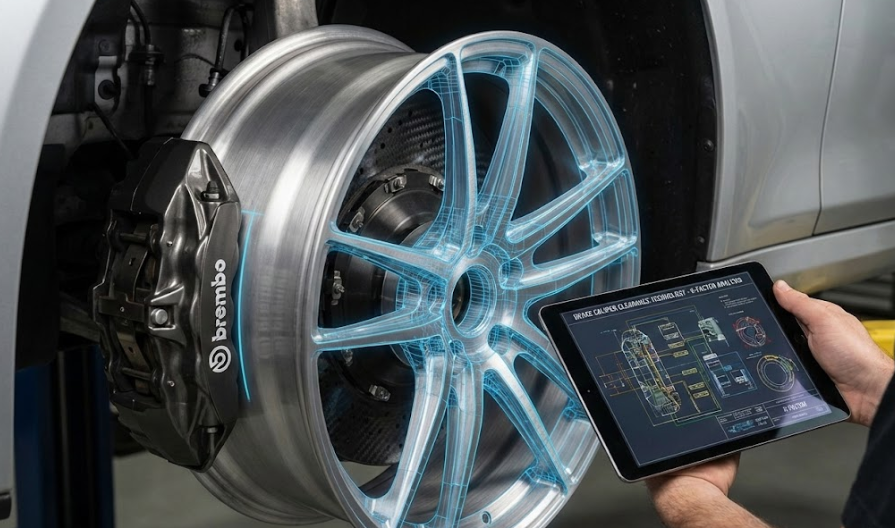
When searching for a professional shop, you should assess their ability to accurately capture their expertise and the technology for diagnosing the problems they will solve for you. Look for these signs.
1. Brake Caliper Clearance Technology (The X-Factor)
The calculation of brake clearance poses a challenge because it is dependent on the curvature of the rear side of the spokes (The X-Factor). A professional shop will never just assume that a 19-inch rim will fit without obstruction with a 380mm big brake kit (BBK). They use a set of proprietary 2D and 3D CAD models from brake manufacturers (like Brembo or Wilwood) to check spoke sweep.
- Clearance Tolerance:Experts require at least 3mm to 4mm of space from the caliper face to inner spokes to accommodate thermal expansion from heavy braking. Many enthusiasts choose circuit performance wheels because they are often designed with this specific brake clearance in mind.
2. Use of Specialized Fitting Equipment
Based on experience, professional technicians know better than to make claims based on guesswork or internet forums. For example, they use a Percy’s WheelRite simulator to create a physical mock-up of the hub’s exact diameter, width, backspacing, and tire profile limits. They cycle the suspension through the full range of motion to determine where potential rubbing might occur.
3. Understanding of Load Ratings
All vehicles have a Gross Vehicle Weight Rating (GVWR). A professional shop determines the static and dynamic load indices based on the exact specifications of your chassis. Using a lightweight tuner wheel rated for 1,200 lbs on a heavy electric vehicle (EV) or 3/4-ton diesel truck is a recipe for disaster. Experts check that the JWL or VIA stamped load rating is sufficient.
4. Tire Pairing and Stretch Dynamics
The rim is only half of the equation. The tire beads dictate the stiffness of the sidewalls and the shape of the contact patch.
- Square Setup:The tire’s sidewall is vertical to the flange. This offers the most mechanical grip and a predictable breakaway.
- Stretched Fitment:This is when a narrower tire is fitted to a wider barrel. Pro shops know the safe tire stretch limits. If you over stretch, you risk losing bead seal.
Red Flags: What To Avoid When Selecting A Shop?
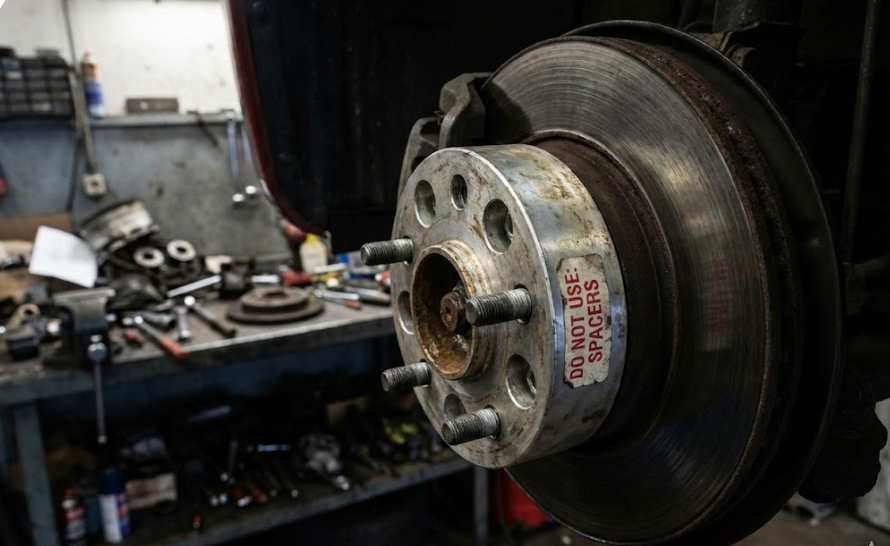
While knowing what to look for is important, you must know the signs of amateur, inexperienced, or even unethical shops.
1. Reliance on Wheel Spacers
If a shop recommends thick, slip-on wheel spacers to cure a bad offset, steer clear. Spacers change the scrub radius, increase the leverage on hub bearings, and reduce engagement of the lug nut thread. If a spacer is required, a pro shop should use a high quality, hub-centric, bolt-on spacer adapter that is forged aluminum.
2. Wrong Choice of Hardware
Not all lug nuts are the same. The seating profile of lug nuts is a matter of precision engineering.
- Conical (Acorn) Seat:This has a 60-degree taper and is typical of 90% aftermarket applications.
- Ball (Radius) Seat:This has a rounded base and is used on OEM European cars.
- Mag (Flat) Seat:Uses a flat washer to spread clamping force.
Using a conical lug nut on a ball-seat rim causes pinpoint stress fracturing leading to wheel separation.
3. Not Following Post-Installation Instructions
A shop’s work begins when the car rolls off the lift.
- Torque Sequences:Experts guide hardware torquing in a star pattern on a calibrated manual torque wrench.
- Re-Torque:They instruct you to come back after 50-100 miles of driving to re-torque the lugs because of initial seating relaxation.
Knowing Safety Certifications!
When looking through professional shop catalogs, the model on display will be facing you. Flip the display model to see the stamping on the rear of the spokes. Authoritative shops only sell items that have passed certain safety standards regarding international metallurgical testing.
- JWL:A very controlled set of criteria established by the Japanese government.
- VIA:According to Kipardo, VIA ensures compliance with JWL through independent lab testing.
- TÜV:Extreme European certification involving analysis of material strength and long-term fatigue.
Finishes and Their Importance for the Long-Term!
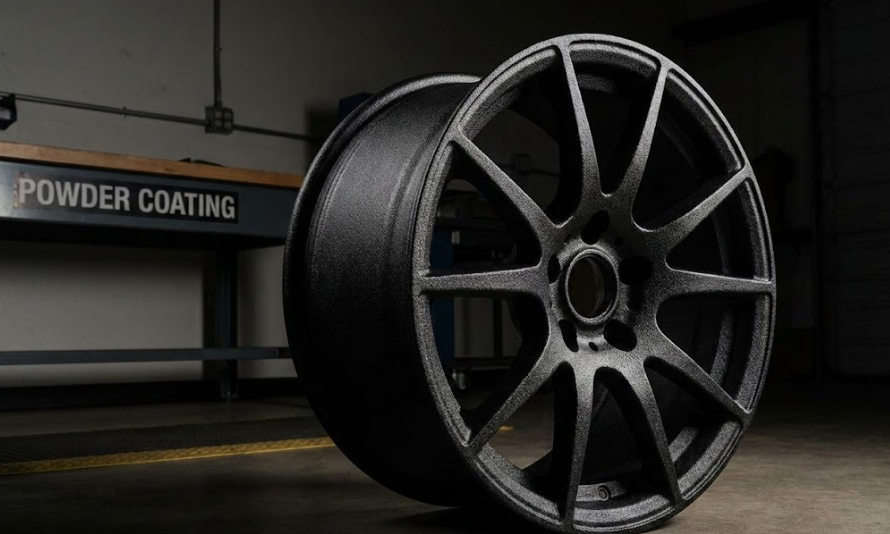
The finish is the first layer of defense. It protects the surface from oxidation, corrosion from road salts, and brake dust etching.
– Powder Coating
In the aftermarket industry, the ultimate standard is powder coating. The powder must be baked at about 400 degrees Fahrenheit.
- Benefits:Resistant to scratching, chipping, and chemical breakdown.
- Disadvantage:Not the easiest to repair if damaged.
– Liquid Paint and Clear Coat
Liquid Paint is the classical form of automotive lubricant that is sprayed onto surfaces.
- Advantages:Possible to achieve an exact match of the original manufacturer’s automotive paint color.
- Disadvantages:Susceptible to rock chips and requires frequent waxing.
– Brushed and Clear Anodized
The raw aluminum is first cut with CNC machining and then hand-brushed. The surface is then covered by a clear coating called anodizing.
- Pros:Shows practical artistry and is popular in high-end custom markets.
- Cons:Can fade due to high levels of UV light exposure if not maintained.
Pro Shop Consultation Overview: Step-by-Step!
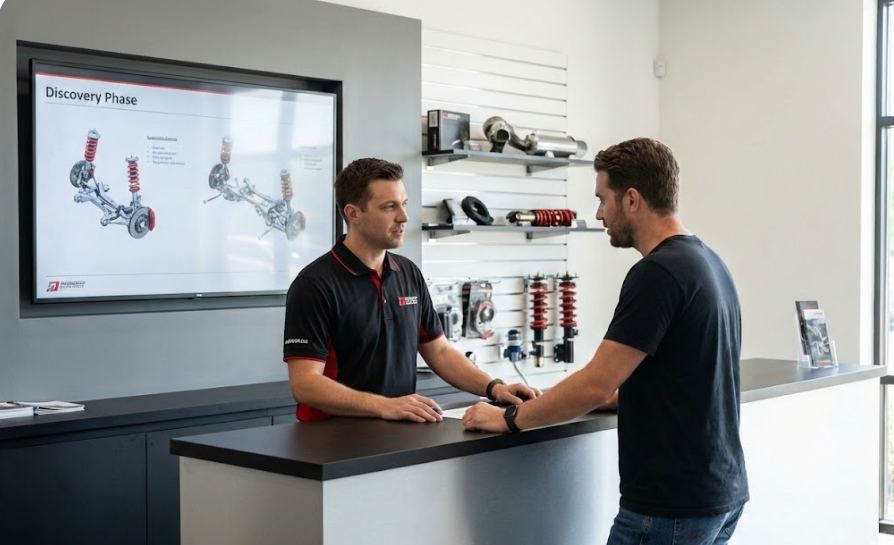
What can you expect when you enter a high-end shop?
Step 1: Discovery Phase
The shop technician will ask you a series of questions concerning your needs. They will ask what type of suspension you have and what modifications you plan to do in the future.
Step 2: Measurements
The car is put on the lift. The technician records the hub-to-fender distance and takes into account the natural camber arc of the suspension.
Step 3: The Pitch
Using the previously collected data, the shop will provide you with recommendations. They will explain why certain custom performance wheels are more desirable for your specific goals.
Step 4: Precision Mounting and Road-Force Balancing
Once the hardware arrives, pro shops use touchless tire mounting machines to avoid scratching the lip. They use Road-Force Balancing machines to ensure a glass-smooth ride by matching the tire’s stiffest part with the rim’s lowest point. This is especially important when installing Ford performance wheels on a truck that will see high highway speeds.
Conclusion!
Finding a highly trustworthy professional shop guarantees a flawless installation. With forged performance wheels, the vehicle dynamics will improve significantly. Expert advice prevents fitment errors, and high-quality workmanship will provide reliability at high speeds for a long time. For the best custom rims, go to RizoForged. You can improve your experience while driving at a high level of confidence.
 EN
EN  ES
ES  PL
PL  JA
JA  IT
IT