
Does your rubber grip enough to make a hairpin turn on the road? Picking the correct motorcycle tires means you need to know about compounds, tread patterns, and construction types. We deconstruct tire specs to help you nail the ideal traction match for your own riding today.
Motorcycle Tire Anatomy And Construction Explained!
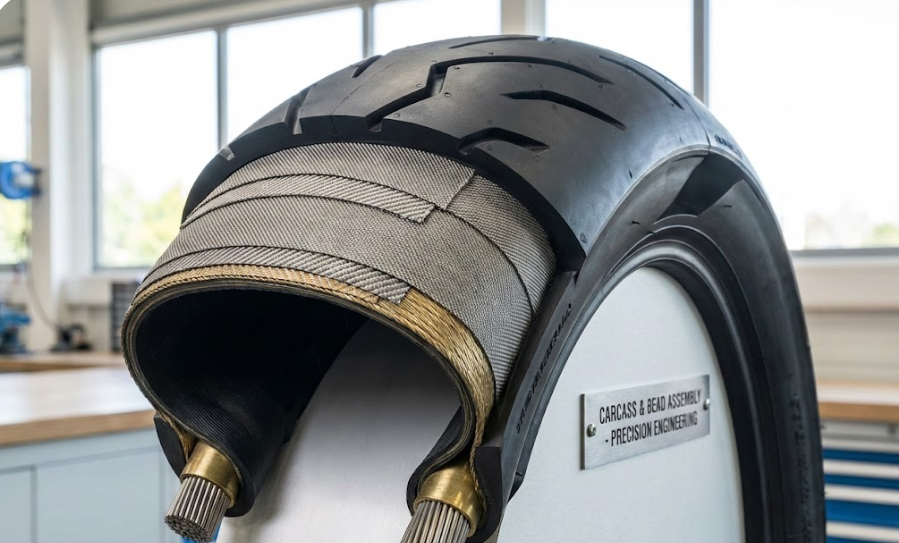
The interface of your machine to the ground involves a long array of complex designed devices. There is a lot more to selecting the right rubber for your application, but knowing what is inside a motorcycle tire is square one. The tire is not just a rubber donut, but a vital suspension element which deforms, absorbs impacts, and controls sideways forces. Have you ever wondered how much engineering goes into that small contact patch?
o The Carcass and of Bead Assembly
The carcass serves as the inside of the tire body located under the tread. It is the shape that contains air and supports the total weight of the motorcycle.
- Bead:This is the part of the tire that anchors it to the wheel, and it is usually a steel wire encased in thick rubber. It forms a tight seal between the rim and tire to keep the tire from slipping under sudden acceleration.
- Sidewall:Bridging the tire with the wheel, the sidewall determines how the tire will handle on the road. A sidewall that is shorter overall will usually result in a stiffer profile and less flex. This offers better edge control but does not provide as good bump absorption.
- Tread:This is the specific part of the tire that actually touches the ground surface. Less aggressive treads put more rubber in contact with pavement for grip. However, more open and chunky patterns are designed to channel water out of the way or grip loose paths off-road.
o Radial vs. Bias-Ply
There are two primary tire construction types, and each offers unique characteristics depending on the weight of the motorcycle. Do you know which construction type your current bike uses?
- Radial Tires:These are constructed with the ply cords running across from bead to bead at a 90 degree angle. The reinforcing belts are usually made of steel.
- Pros:The sidewall and tread operate independently thanks to the radial construction. Less heat is also produced, which helps to increase the overall life of the tire. They tend to have a lower profile ratio for greater cornering stability on sportbikes.
- Bias-Ply Tires:These have belts made of fiber cords like polyester or aramid that run across the tread from side to side. These cords are placed at an angle of 30 to 40 degrees.
- Pros:The bias design gives you a stiffer carcass from end to end. This is a much better design for supporting heavy loads. That is why bias-ply tires are stock equipment on heavy cruisers and touring motorcycles.
Sidewall Markings and Metrics Decoding!
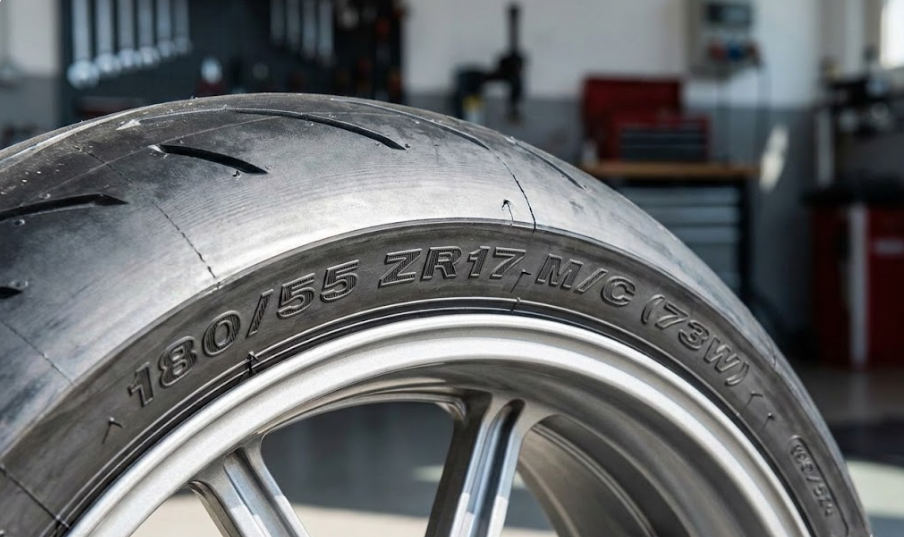
By federal law, key data must be molded into the tire sidewall. By reading these codes you can check the fitment, age, and capabilities. In the case of sizing, there are usually two systems which are alphanumeric and metric. As Lemmy from RevZilla notes, “By law, this information is written on the tire sidewall.”
How to Read Metric Sizing?
Try translating metric sizing with a popular sport-touring tire example like 180/55 ZR17 M/C (73W). RizoForged experts suggest always verifying these numbers before you buy new rubber.
- 180 (Tread Width): This stands for the measurement of the tire across the tread face in mm. Real widths may slightly differ between manufacturers due to the shape profile.
- 55 (Aspect Ratio): The height of the sidewall is 55% of the tire width. In this example the sidewall height is 99mm.
- Z (Speed Rating Category): This tire is rated for speeds in excess of 149 mph.
- R (Construction): This denotes radial construction. A hyphen signifies bias-ply, and a B stands for bias-belted.
- 17 (Rim Size): This is the diameter of the wheel expressed in inches.
- M/C: This indicates the tire is manufactured specifically for a motorcycle.
- 73 (Load Index): This is a numerical code which indicates the maximum load carrying capacity of a tire.
- W (Speed Symbol): This is the speed for which the tire is rated. A W stands for 168 mph.
The Significance of DOT Date Codes!
Regardless of tread depth, rubber will degrade from exposure to oxygen and UV light. You need to find the DOT code on the sidewall, which contains the last four digits. How long do motorcycle tires last in your garage before they get hard?
- How to read the code: The first two digits indicate the production week, while the last two are for the year.
- Example: A code of 4223 indicates the tire was made in the 42nd week of 2023.
- Safety Rule: Tires that are over five years old should be checked out by a pro. As a rule of thumb, tires more than 10 years old are considered unsafe. They need to be replaced due to hardening of rubber that cannot ensure grip anymore.
Analyzing the Different Types of Tires and Compounds!
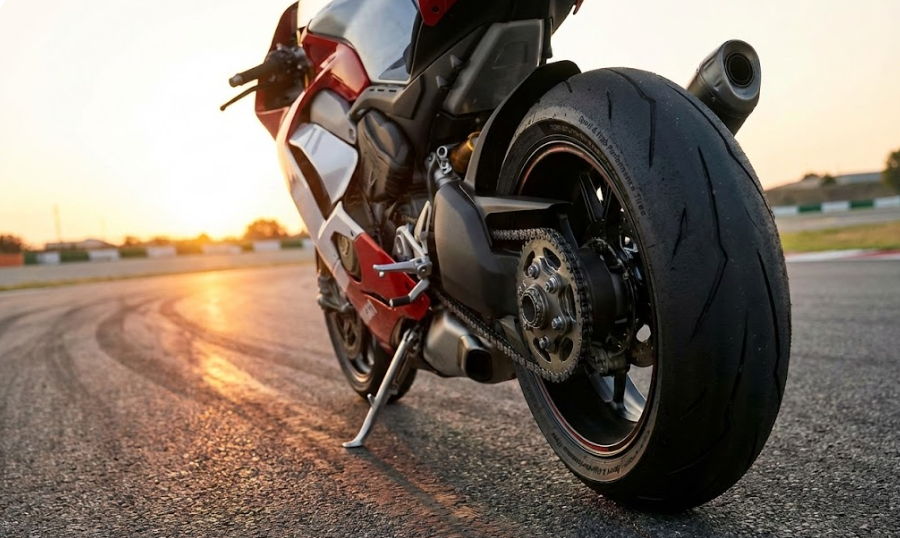
Motorcycle tires are specialized tools for different riding styles. The rubber compound is quite different to strike a balance between grip and longevity.
ü Sport & High-Performance Tires
For aggressive street riding and track days, these prioritize grip over longevity. They are often made with soft rubber compounds to maximize traction.
- Profile: They have an angular or deep V-shaped profile. This has the effect of increasing the contactpatch surface when cornering.
- Compound: Soft rubber compounds need heat to stick to the road surface. They break down fast even if they grip really well during turns.
- Caution: These are track-oriented tires and in many cases they will not heat up to an optimal temperature on the street.
ü Touring & Cruiser Tires
These were developed to provide a long, stable, and wet-weather confident ride. They are designed for riders who spend a lot of time in the saddle.
- Profile: Flatter profiles keep you steady on the straight road.
- Compound: They use a harder compound to resist highway miles and towing.
- Reinforcement: Stronger sidewalls support the weight of passengers and luggage.
- Multi-Compound Technology: Many modern sport touring tires feature two compounds to maximize cornering grip and reduce tire wear.
ü Adventure (ADV) and Dual-Sport Tires
These need to accommodate both on-road steadiness and off-road stick. They are typically rated by the percentage of travel, such as 70% street and 30% dirt.
- Tread Block: The deeper grooves and specific blocks enable the tire to grip loose surfaces like gravel or mud.
- Trade-off: On pavement, the compliant tread blocks can give a vibration. They provide less contact patch than a street tire, so confidence around corners is reduced.
| Tire Category | Profile Geometry | Rubber Compound | Primary Usage | Technical Feature |
| Sport / Track | Angular / Deep V-Shape | Soft / High-Hysteresis | 90% Track / 10% Street | Maximum Contact Patch |
| Touring | Flat / Round | Hard / Silica-Rich | 100% Long Distance | Dual-Compound (2CT) |
| Cruiser | Stable / Wide | Ultra-Hard | Heavy Load / Highway | Reinforced Sidewalls |
| Adventure | Hybrid / Moderate | Mid-Density | 70% Road / 30% Dirt | Varied Aspect Ratios |
| Off-Road | Knobby / Block | Specialized Pliable | 100% Loose Terrain | Self-Cleaning Grooves |
Performance Comparison of Specialized Motorcycle Tires!
Tire Condition, Inspection and Maintenance!
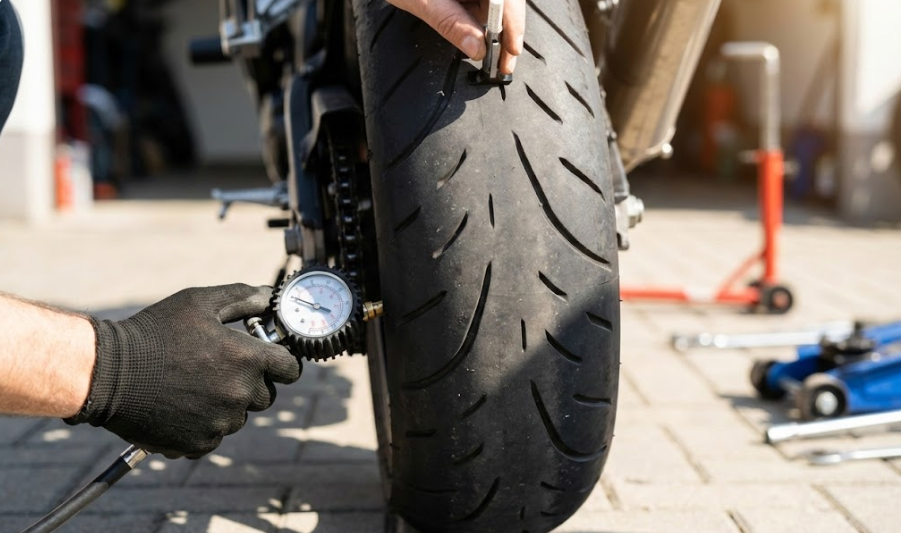
The traction connecting your bike to the road can be unstable if neglected. According to the Motorcycle Safety Foundation, “Deterioration of your tires’ condition can jeopardize this contact patch and bring a good ride to a quick end.”
– Inflation Pressure Maintenance
Maintaining proper tire inflation is the most important thing you can do to avoid problems. Have you checked your motorcycle tire pressure gauge this week?
- Under Inflation: This results in excessive sidewall flexing which generates tremendous heat. This can lead to both de-lamination and a blowout.
- Over Inflation: The contact patchis smaller, which means the tire cannot exert as much grip.
- Protocol: Only check tire pressure when cold after a minimum three-hour rest.
– Tread Depth & Wear Patterns
Modern tires have molded wear bars in the tread grooves. When the tread surface is level with those bars, the tire should be replaced immediately.
- Cupping: Cupped wear patches may represent poor movement and indicate suspension problems.
- Squaring Off: Rear tires on commuter bikes often get a flat spot down the center. That squared profile resists rider effort when trying to turn.
– T-CLOCS Inspection Method
Check your bike prior to every ride using this simple method.
- T (Tires): Examine air pressure and depth of tread. Inspect for any embedded nails or shards.
- W (Wheels): Check rims for dents or cracks and check spoke tension.
- C (Controls): Check the action of levers and pedals.
- L (Lights): Check to make sure brake lights and turn signals work.
- O (Oil): Check for levels and leaks.
- C (Chassis): Check the suspension and chain for looseness.
- S (Stands): Make sure the kickstand gets pushed all the way in.
Technical Modifications and Compatibility!
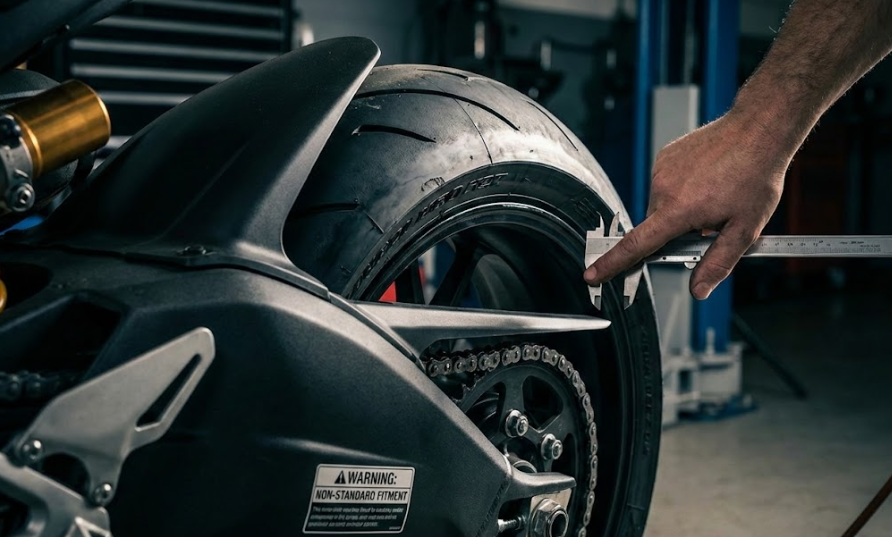
Many riders would love to change tire size for looks or performance. But straying from your OEM specs is fraught with danger.
o The Wide Tire Myth
Try fitting a 190 tire on a rim designed for a 180 and you will notice poor handling.
- Profile Damage: Fit a too wide tire on a skinny rim and you will damage the profile shape.
- Performance: Wider tires typically do not respond as quickly to steering inputs.
- Clearances: Fat tires can rub on the chain or swingarm.
o Mixing Different Tire Styles or Brands
Motorcycles are dependent on balanced tire combinations for safe operation.
- Radial/Bias Mix: Combining different types of structure results in uncontrolled instability.
- Brand Mixing: Mixing brands can result in an inherently unstable system during wet running.
Tube vs. Tubeless Applications!
It is crucial to understand the connection between tire and rim for safety.
- Tubeless Tires: Standard on modern street bikes with aluminum rims.
- Tube Type Tires: Necessary for most spoked rims as the holes are not sealed.
- Limitation: You cannot run a tubeless tire on a tube-type rim without an inner tube. Adding a tube to a tubeless tire adds friction and heat.
Common Tire Selection Mistakes!
Avoid these pitfalls to ensure you get the best value and safety.
- Disregarding Load Ratings: A tire with a lower than stock load index may not carry the weight.
- Purchasing Based On Aesthetic: Aggressive treads look good but can cause noise and rapid wear.
- Buying Race Take-Offs: It is highly dangerous to buy used race tires for street use.
Conclusion
The only thing between you and danger on a bike is the small area that meets your motorcycle tires to the road. Monitor tread depth frequently and if any of the rubber is over five years old discard it before you lose touch. Visit RizoForged to find high quality custom rims that back your new rubber setup.
FAQs!
Why Can’t I Patch Up My Motorcycle Tire That Got Punctured?
A motorcycle tire repair should be a temporary move to get you home. Speed ratings become invalid when a tire is repaired.
What Is Tyre “Scrubbing In”?
New tires have a slippery surface from production and need to be broken in. Ride moderately for the first 100 miles to maximize grip.
Can I Put A Car Tire On My Motorcycle?
No, this is extremely dangerous. Applying them to a motorcycle cuts down the contact patch during lean.
How Do I Tell If My Tire Is Directional?
Most motorcycle tires are directional to evacuate water. There should be an arrow on the sidewall showing the direction.
 EN
EN  ES
ES  PL
PL  JA
JA  IT
IT